


Welcome to AviationOutlook: The aviation newsletter built exclusively for decision-makers.
Become an “Annual” member now & get this special discount offer.
As a paid member, you get access to:
200+ Reports - All major airlines + aerospace & defense companies (updated regularly).
Daily / Weekly - Deep-dive analysis & insights.
Monthly - Industry outlook reports.
In case you missed it, here are the latest analysis reports:
Embraer - Company Analysis and Outlook Report 2026 (Updated)
American Airlines’ Six-Route Europe Play: Yield Discipline or Widebody Overreach?
Check Out All Reports
Executive Summary
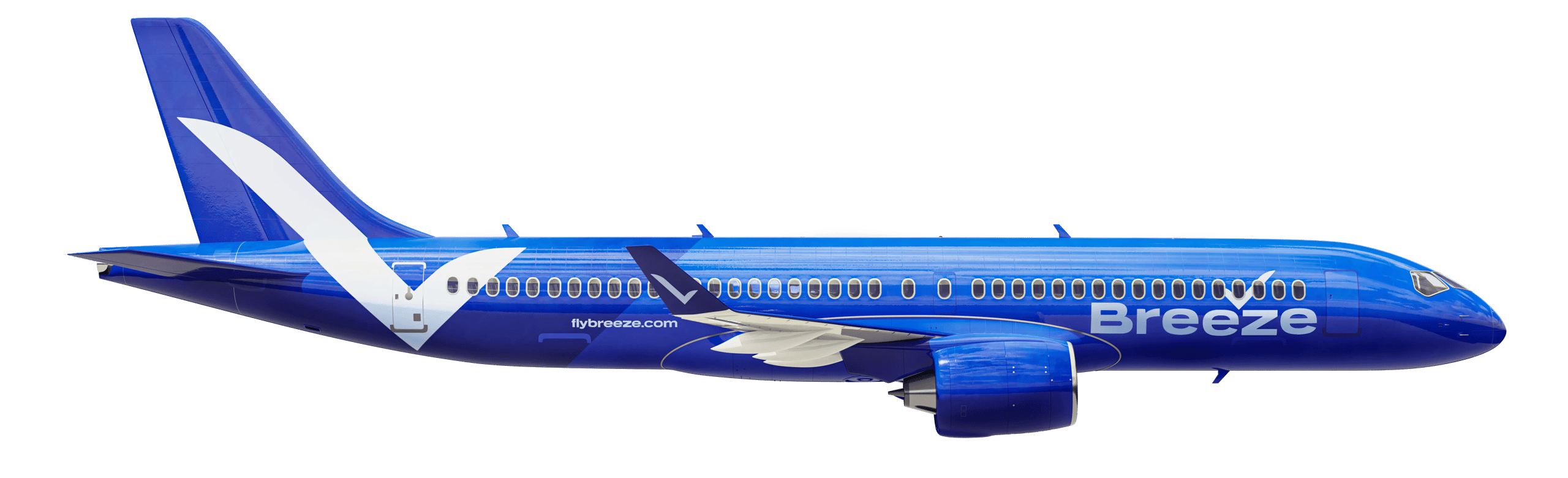
Breeze Airways crossed the 50-aircraft Airbus A220-300 milestone in early May 2026, celebrated at the Mobile, Alabama assembly line, and now takes deliveries roughly every three weeks toward a firm order of 90 airframes.
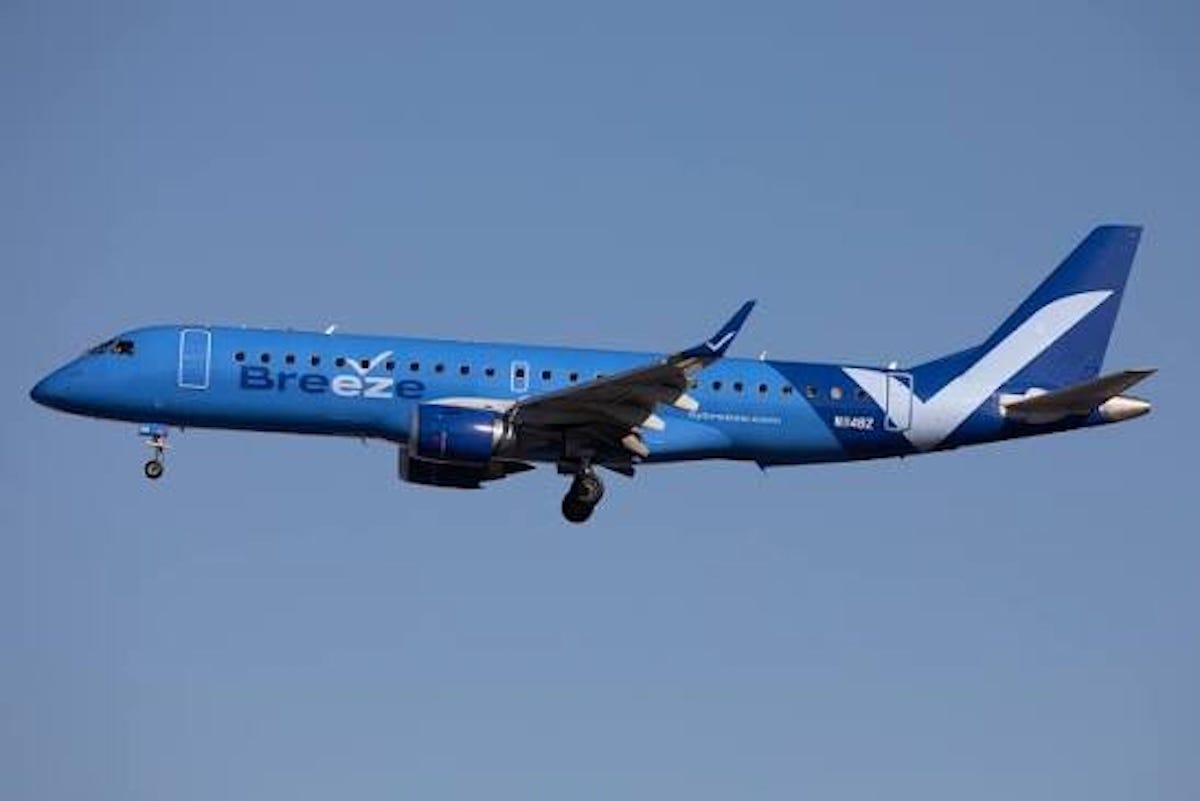
The airline has fully retired its Embraer E195 fleet and is winding down its remaining Embraer E190s, with the Brazilian narrowbodies scheduled to exit scheduled service by mid-2026 and continue only in charter roles.
Breeze became the first newly certified U.S. flag carrier in a decade in September 2025, unlocking A220-300 international operations to Cancun, Punta Cana, Montego Bay, Nassau and Costa Rica.
Founder David Neeleman has publicly floated a long-term fleet ambition of up to 400 aircraft, anchored by a single-type A220 strategy and the point-to-point secondary-city model.
Recommended Reports


Read All Reports
Introduction
Fifty Airbus A220-300s in five years is not a slow burn for a startup airline.
It’s a compounding fleet build, and it has quietly turned Breeze Airways from a Utah startup with borrowed Embraers into the fastest-growing single-fleet operator of the A220 family in the Western Hemisphere.
For fleet planners and airport authorities watching what happens when a low-cost carrier chooses a premium regional jet as its only aircraft, 2026 is the year the thesis gets tested.
Every three weeks, another 137-seat airframe rolls off the Mirabel or Mobile line and takes up a route no other major U.S. carrier finds worth flying nonstop.
This report walks through the composition of the current fleet, the aircraft that are leaving it, the aircraft still to arrive, and the operational choices that make Breeze’s fleet strategy unusual inside the U.S. airline industry.
Let’s analyze everything in detail.
The Fleet as It Stands in 2026
Breeze Airways today operates a two-type fleet in transition, moving decisively toward a single-fleet A220-300 operation. The composition matters because it explains the carrier’s cost curve, its crew training pipeline, and its route economics.
The operating fleet stands at 69 aircraft in total with an average age of roughly 4.5 years, one of the youngest of any U.S. scheduled operator.
Of that total, 50 are Airbus A220-300s and the balance are aging Embraer E190s used mostly for charter work.


The airline crossed the 50th A220 threshold in early May 2026, an event celebrated at the Airbus Mobile facility rather than at the Mirabel plant in Quebec.
That location choice was symbolic: Mobile now assembles A220 airframes for U.S. customers, shortening the delivery chain for Breeze.
BREEZE AIRWAYS OPERATING FLEET (July 2026)
Airbus A220-300 ............ 50 active
Embraer E190 ............... ~8 active (charter and scheduled fill)
Embraer E195 ............... 0 (retired April 2025)
Firm A220 backlog .......... ~40 aircraft remaining
Delivery cadence ........... one aircraft every ~3 weeks
Fleet average age .......... approx. 4.5 yearsWhy the Fleet Age Number Matters
A young fleet compresses maintenance reserves, reduces AOG events, and lets the carrier operate long sectors profitably on the type’s newest GTF engines.
For an airline planning transcon and near-international flying on a narrowbody, the fuel burn advantage of a fleet averaging under five years is measured in dollars per departure.
That number is what allows Breeze to price its Nice fares at levels that legacy carriers cannot match on the same city pair.
The Airbus A220-300 as the Only Aircraft That Matters
The A220-300 is not just Breeze’s largest fleet type. It’s the entire commercial thesis of the airline. Every network decision made since 2022 flows from what this specific airframe can do on a specific range and cost profile.
Breeze originally signed a memorandum of understanding for 60 Bombardier CS300s in 2018, before Airbus acquired the program and renamed the aircraft.
Firm orders followed, and additional purchases in 2019 and again in February 2024 brought the total firm book to 90 aircraft, with purchase rights that could extend the total to 120.
Cabin Configuration in Detail
Breeze operates the A220-300 in a 137-seat configuration that is unusual for a low-cost carrier. The layout mixes 12 first-class-style seats branded “Nicest,” 45 extra-legroom “Nicer” seats, and 80 standard “Nice” seats in a 2-3 arrangement.
The Nicest cabin uses a 2-2 layout with 20.5 inch wide seats and 39 inches of pitch. Nicer seats deliver 33 inches of pitch at 18 inches wide, and standard Nice seats maintain 30 inches of pitch and 18 inches of width.
David Neeleman has publicly said the carrier underestimated premium demand and wants to grow first-class inventory. In a recent industry conversation he indicated a preference to expand the Nicest cabin from 12 seats to as many as 20 on some airframes, particularly those flown on longer sectors.
That’s a meaningful signal for fleet planners because it implies Breeze may operate multiple A220-300 subfleets with different cabin densities depending on mission type.
Transcon and near-international routes would receive higher-premium configurations, while thin regional missions retain the current 137-seat layout.
A220-300 CABIN LAYOUT AT BREEZE (BASE CONFIGURATION)
Nicest (First-style) ...... 12 seats  | 2-2 | 39" pitch | 20.5" wide
Nicer (Extra legroom) ..... 45 seats  | 2-3 | 33" pitch | 18" wide
Nice (Standard) ........... 80 seats  | 2-3 | 30" pitch | 18" wide
Total .................... 137 seats
Wi-Fi ..................... Yes (streaming, complimentary in premium)
Power ..................... Universal AC and USB at all seatsThe GTF Engine and Range Envelope
Every Breeze A220 is powered by the Pratt & Whitney PW1500G, part of the geared turbofan family.
Breeze finalized engine agreements for its A220 fleet powered by GTF engines covering the full 80-airframe base order plus subsequent additions.

The engine is central to the aircraft’s economics. It delivers up to 25 percent lower fuel burn per seat compared to previous generation narrowbodies, along with meaningfully lower NOx emissions and a much quieter acoustic footprint.
From a network planning perspective the A220-300 offers a range envelope of roughly 3,400 nautical miles. That range is what makes Breeze’s transcon and Caribbean flying viable on a single-aisle aircraft, and it is why the airline can genuinely study routes it could not have considered with older 100-seat jets.
Pratt & Whitney’s GTF has had well-documented durability issues in earlier variants across the wider global fleet.
Breeze has continued to take deliveries throughout that period, indicating that its own reliability experience has remained within acceptable operational parameters for the carrier’s mission mix.
The Embraer Phase-Out and What It Means
The Embraer chapter at Breeze is closing, but not as cleanly as the airline once implied.
Understanding the phase-out matters because