


Executive Summary
Hanwha Aerospace closed fiscal year 2025 with record consolidated sales of approximately KRW 26.6 trillion, representing year-on-year revenue growth of roughly 137%, while operating profit rose to KRW 3.03 trillion, a 75% jump driven primarily by surging European K9 howitzer and Chunmoo deliveries.
The company’s ground-defense backlog alone reached 37.22 trillion won at end-2025, providing a multi-year revenue runway anchored by Polish executive contracts, Romanian and Finnish follow-ons, and the first Vietnam K9 export.
Aviation, aerospace, and space platforms (KF-21 propulsion, T700/F404 assembly, Nuri rocket technology transfer, satellite imaging through Satrec Initiative) are positioned to scale meaningfully from 2026 onward as series production of indigenous fighters begins and KARI hands over full Nuri rocket systems integration responsibility.
Strategic risks center on net-profit dilution following the 2025 capital raise, a 4Q 2025 operating-profit miss versus consensus, sustained execution demands across simultaneous European factories, and geopolitical sensitivities around the Austal stake increase that could shape the 2026 to 2030 trajectory.
Recommended - Read Full Reports


Read All Reports
Table of Contents
Executive Summary
Key Facts: Hanwha Aerospace Company Profile
Hanwha Aerospace Company Overview
Origins, Identity and Strategic Positioning in 2026
Corporate Structure and Group Affiliations
Recent Corporate Actions
Key Product Lines, Programs and Services
K9 Thunder Self-Propelled Howitzer Family
K10 Ammunition Resupply Vehicle and K11 Fire Direction Vehicle
K239 Chunmoo Multiple Launch Rocket System
AS-21 Redback Infantry Fighting Vehicle
KF-21 Boramae Engine and Propulsion Programs
Aircraft Engine MRO and Components Business
Naval Gas Turbines and Maritime Systems
Space, Launch and Satellite Solutions
Missile Defense: L-SAM and Cheongung Family
Financial Analysis: Hanwha Aerospace
Top-Line Trajectory: From KRW 11 Trillion to KRW 26 Trillion in One Year
Quarterly Cadence and the 4Q 2025 Miss
Segment Composition
Backlog: The Multi-Year Visibility Anchor
Capital Structure and Shareholder Returns
Liquidity, Leverage and Return Metrics
Revenue and Growth Drivers Through 2026 and Beyond
Driver 1: European Rearmament Cycle
Driver 2: U.S. Naval and Industrial Footprint
Driver 3: Indigenous Aviation Propulsion Build-Out
Driver 4: Space Commercialization
Driver 5: Commercial Aero MRO and Engine Components
Driver 6: Local Production and Industrial Cooperation Packages
Major Competitors and Comparative Analysis
Hanwha Aerospace Competitor Universe
Hanwha Aerospace vs. Rheinmetall AG
Hanwha Aerospace vs. BAE Systems
Hanwha Aerospace vs. Lockheed Martin
Hanwha Aerospace vs. General Dynamics
Hanwha Aerospace vs. Korea Aerospace Industries (KAI)
Hanwha Aerospace vs. Elbit Systems
Competitive Analysis and Structural Moat
Moat 1: Industrial Scale at Korean Cost
Moat 2: Speed of Delivery
Moat 3: Vertical Integration with Hanwha Group Cousins
Moat 4: Government-to-Government Relationship Architecture
Moat 5: Production Localization Strategy
Where the Moat Is Thinner
Other Strategic Positions for 2026 and Beyond
Polish Executive Contract Two and the European Production Hub
Australia: AS-21 Redback Phase Two and Naval Cooperation
Saudi Arabia and the Middle East
South Korea Domestic Demand and the Defense Reform Plan
Korea’s Position in Global Arms Exports
Aviation Industrial Independence
Space Launch Services Market Entry
ESG, Governance and the Value-Up Plan
Financial and Commercial Implications
Implication 1: Sustained Multi-Year Growth Visibility
Implication 2: Margin Compression During Localization Phase
Implication 3: Capital Intensity Through 2028
Implication 4: Currency and Geopolitical Sensitivity
Implication 5: Group-Level Synergy Realization
Key Risks with Probabilities and Scenarios
Risk 1: European Demand Saturation
Risk 2: KF-21 Engine Program Delays
Risk 3: Capital Raise Dilution and ROE Pressure
Risk 4: Geopolitical Shock Affecting Korea-China-U.S. Relations
Risk 5: Competitor Acceleration in Europe
Risk 6: U.S. Political Risk on Austal and Philly Shipyard
Risk 7: Project Execution and Quality Risk
SWOT Analysis: Hanwha Aerospace
My Final Thoughts
Official Sources and Data
Key Facts: Hanwha Aerospace Company Profile
Legal Name:        Hanwha Aerospace Co., Ltd.
Korean Ticker:     KRX 012450
Headquarters:      Seoul, Republic of Korea
Founded:           1977 (originally Samsung Precision)
Renamed:           April 2018 (Hanwha Aerospace)
Parent:            Hanwha Group (7th largest Korean chaebol)
Employees:         ~7,800 (group-level reporting)
Primary Segments:  Aerospace propulsion, Ground defense systems,
                   Space launch and satellites, Naval gas turbines,
                   Aircraft engine MRO
2025 Revenue:      KRW 26.6 trillion (~USD 18.2 billion)
2025 Op. Profit:   KRW 3.03 trillion
2025 Net Profit:   KRW 2.14 trillion
Ground Backlog:    KRW 37.22 trillion (year-end 2025)
Key Subsidiaries:  Hanwha Systems, Hanwha Defence Australia,
                   Hanwha Aerospace USA, Hanwha Philly Shipyard,
                   Satrec Initiative (~30% stake), Austal (19.9%)
Source:            Hanwha Aerospace IR releases & filings
The combination of artillery export volume, indigenous fighter integration work, and a deepening U.S. industrial footprint via Philly Shipyard now makes Hanwha Aerospace one of the most strategically diversified pure-play defense and aerospace primes in the Asia-Pacific region.
Hanwha Aerospace Company Overview
Origins, Identity and Strategic Positioning in 2026
Hanwha Aerospace traces its industrial lineage to 1977, when it was established as the precision-machining and aircraft-engine arm of Samsung. Following multiple ownership changes, the business was acquired by Hanwha Group in 2015 and rebranded as Hanwha Aerospace in April 2018.
By April 2026, the company has consolidated itself as Korea’s flagship private aerospace and defense manufacturer, sitting at the center of Hanwha Group’s “Aerospace and Mechatronics” pillar.
It coordinates ground-defense exports, aviation propulsion, space-launch capability and a rapidly expanding overseas industrial network spanning Australia, Romania, Vietnam, Poland and the United States.
The 2025 corporate “Value-Up” plan published on the Korean stock exchange explicitly framed the company as a globally diversified prime contractor rather than a regional artillery exporter.
That framing matters because the 2026 narrative is increasingly about platform integration, not single-system sales.
HANWHA AEROSPACE STRATEGIC PILLARS

Pillar 1: Land Systems Powerhouse
  - K9 Thunder, K10 ARV, K2 components, AS-21 Redback,
    K239 Chunmoo, KAAV-II amphibious vehicle

Pillar 2: Aviation Propulsion Sovereignty
  - GE F404/F414 licensed assembly, T700 helicopter engines,
    KF-21 indigenous engine development (15,000-16,000 lbf)

Pillar 3: Space and Launch Vehicles
  - Nuri (KSLV-II) full system technology transfer,
    Satrec Initiative satellite manufacturing

Pillar 4: Naval and Maritime
  - LM2500 gas turbines, MASGA cooperation,
    Austal stake (US shipbuilding bridge)

Pillar 5: Missile Defense and Long-Range Fires
- L-SAM, Cheongung, Chunmoo guided rocketsCorporate Structure and Group Affiliations
Inside the wider Hanwha conglomerate, Hanwha Aerospace functions as the listed flagship for defense exposure.
It controls or holds significant stakes in Hanwha Systems, the group’s electronics, radar and C4I specialist, which separately reported KRW 30.9 billion-class quarterly sales rolling up under aerospace consolidation logic.
The company also fully owns Hanwha Defence Australia, the prime contractor for the AS-21 Redback infantry fighting vehicle program, and operates a U.S. presence through Hanwha Aerospace USA along with Hanwha Philly Shipyard, following the 2024 acquisition of Philly Shipyard for around USD 100 million.
In late 2025, Australia cleared Hanwha to expand its stake in shipbuilder Austal Limited from 9.9% to 19.9%, making the Korean group Austal’s largest shareholder. The transaction sits within the broader MASGA (Make American Shipbuilding Great Again) cooperation framework that gives Hanwha access to U.S. and Australian naval supply chains.
Within Korea, Hanwha Aerospace also holds approximately 30% of Satrec Initiative, the country’s leading commercial Earth-observation satellite manufacturer, providing exposure to high-resolution imaging applications such as the SpaceEye-T platform.
Recent Corporate Actions
The 2025 calendar year was unusually active in capital-markets terms. Hanwha Aerospace initially announced an ambitious paid-in capital increase of KRW 3.6 trillion before scaling the offering back to roughly KRW 2.3 trillion in response to retail-shareholder pushback over allocation mechanics.
Affiliates of the Hanwha Group separately committed to acquiring approximately KRW 1.3 trillion in newly issued shares, signaling internal confidence and locking in long-term parent-level commitment.
These moves were intended to fund the next leg of growth: U.S. shipbuilding investment, KF-21 engine development, European production facilities, and inorganic growth through the Austal stake increase.
Stakeholders should judge management partly on whether dilution translates into compounding returns over the coming five years.
Key Product Lines, Programs and Services
K9 Thunder Self-Propelled Howitzer Family
The K9 Thunder, a 155mm/52-caliber tracked self-propelled howitzer, remains the single most important revenue and brand asset in Hanwha Aerospace’s portfolio.
The platform was developed in the 1990s by the Agency for Defense Development with Samsung Techwin (now Hanwha Aerospace) as prime, and has since become the most widely exported self-propelled gun on the planet.
The K9 family combined with the K10 ammunition resupply vehicle holds roughly a 60 percent share of the global mobile artillery market.
The K9 has been ordered by South Korea, Turkey, Poland, India, Finland, Norway, Estonia, Australia, Egypt, Romania, the United Kingdom and Vietnam, with cumulative export contracts crossing the 14 trillion won threshold in early 2026.
K9 EXPORT SCORECARD (PUBLICLY DISCLOSED CONTRACTS)

Poland       - 212 K9A1 (EC1) delivered + 152 K9PL/EC2 in execution
Romania      - 54 K9 + 36 K10 (~USD 938m), local plant under build
Finland      - 48 originals + 38 follow-on + 112 add-on (€546m)
Norway       - 24 K9 (separate from Chunmoo deal)
Australia    - 30 AS9 + 15 AS10 under HUNTSMAN program
Egypt        - 216 K9EGY package (~USD 1.66b)
United Kingdom - K9A2 selected for British Army Mobile Fires Platform
Estonia      - 24 K9 Kõu (delivered)
Vietnam      - 20 K9 (~USD 250m, 2025 G2G contract)
India        - K9 Vajra-T license production (Larsen & Toubro)
The Finnish follow-on contract signed in 2026 exemplifies how the franchise compounds: existing operators repeatedly return to expand fleets because logistics, training and ammunition supply are already proven within their armies.
The K9A2 variant introduces an autoloader, a bigger chamber, longer range and a digitized fire-control suite, which the British Army has chosen as the future “Mobile Fires Platform.” The K9A3 concept, currently in development, targets full unmanned operation, an evolution that aligns with NATO’s growing demand for crew-saving artillery solutions.
K10 Ammunition Resupply Vehicle and K11 Fire Direction Vehicle
The K10 is the K9’s ammunition resupply companion, capable of automatically transferring 155mm rounds without exposing crews. The K11 Fire Direction Vehicle complements both, completing a battery-level package that customers increasingly buy as a system rather than a single platform.
Romania’s recent contract covering 54 K9 and 36 K10 units illustrates the trend: customers are paying premiums for integrated artillery battalions, not isolated tubes. This has the additional commercial benefit of locking in ammunition handling supply chains for decades.
ARTILLERY SYSTEM ARCHITECTURE

K9 Howitzer (firing platform, 155mm/52cal)
   ↓
K10 ARV     (auto-resupply, ~104 rounds capacity)
   ↓
K11 FDC     (fire-direction & C2 nodes)
   ↓
K-MFCS      (Korean Mobile Fire Control System)

Result: A self-contained, deployable artillery battalion
package optimized for high-tempo Western-style maneuver
warfare with NATO-standard ammunition compatibility.K239 Chunmoo Multiple Launch Rocket System
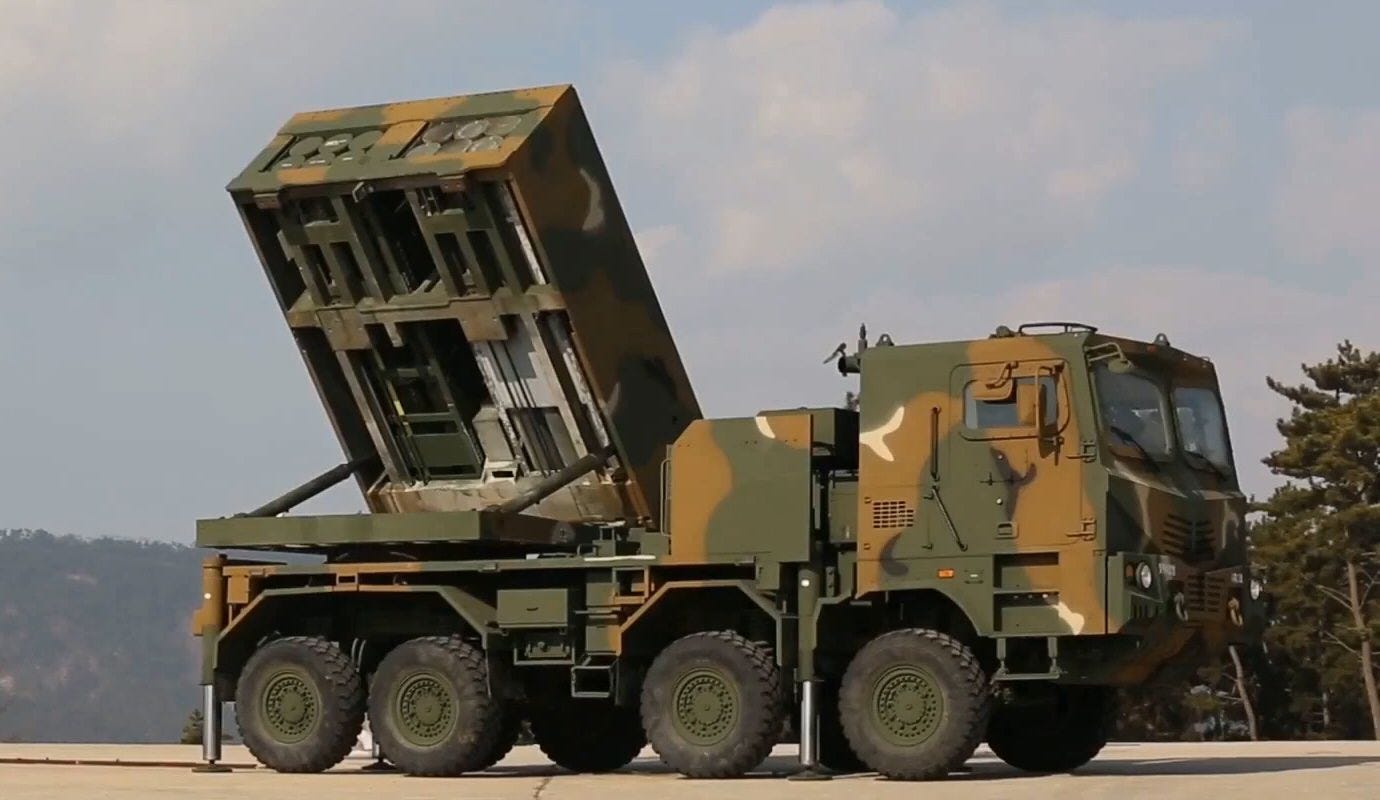
The K239 Chunmoo is Hanwha Aerospace’s modular multiple-launch rocket system, capable of firing a range of munitions from 130mm rockets to 600mm tactical ballistic missiles, with engagement distances stretching into the hundreds of kilometers depending on payload.
The system entered service with the South Korean army in 2015 and has since become a strategically important export.
Poland was the launch international customer with a multi-billion-dollar order. In 2025, Norway selected Chunmoo over the U.S. HIMARS in a contract worth USD 922 million, a milestone that demonstrated the platform’s competitiveness in NATO procurement.
The Chunmoo’s modular pod design, ability to fire multiple calibers from the same launcher and price point relative to U.S. equivalents have positioned it as an attractive alternative for European militaries rebuilding stockpiles.
Unveiled in late 2025, the HPMRL marine variant at roughly 19 tons creates a lighter, expeditionary derivative for amphibious operations.
CHUNMOO PAYLOAD MENU (TYPICAL)

130mm rockets    - 36 round pod, ~36 km range
227mm rockets    - 6 round pod, ~80 km range (CGR)
239mm rockets    - 12 round guided pod, ~80 km
400mm KTSSM-II   - tactical ballistic, ~290 km
600mm KTSSM      - heavy precision, deep-strike role

Single launcher swaps pods in minutes,
allowing one chassis to deliver several mission profiles
within the same fire mission window.AS-21 Redback Infantry Fighting Vehicle
The AS-21 Redback was selected by the Australian Department of Defence in 2023 to fulfill the LAND 400 Phase 3Mounted Close Combat Capability requirement, beating the German Lynx in a decisive procurement decision.
Manufacturing is being executed at the H-ACE (Hanwha Armoured Vehicle Centre of Excellence) facility in Avalon, Victoria. In April 2026, Hanwha confirmed an additional partnership with South Australian electronics specialist REDARC to supply critical sub-systems, deepening the program’s local content footprint.
The Redback shares its drivetrain and mobility lineage with the K21 IFV but introduces a heavier turret, advanced active protection, and a digital fire control suite. Romania has now signed a memorandum of understanding for the AS-21, opening up a second major export market for the platform.
KF-21 Boramae Engine and Propulsion Programs
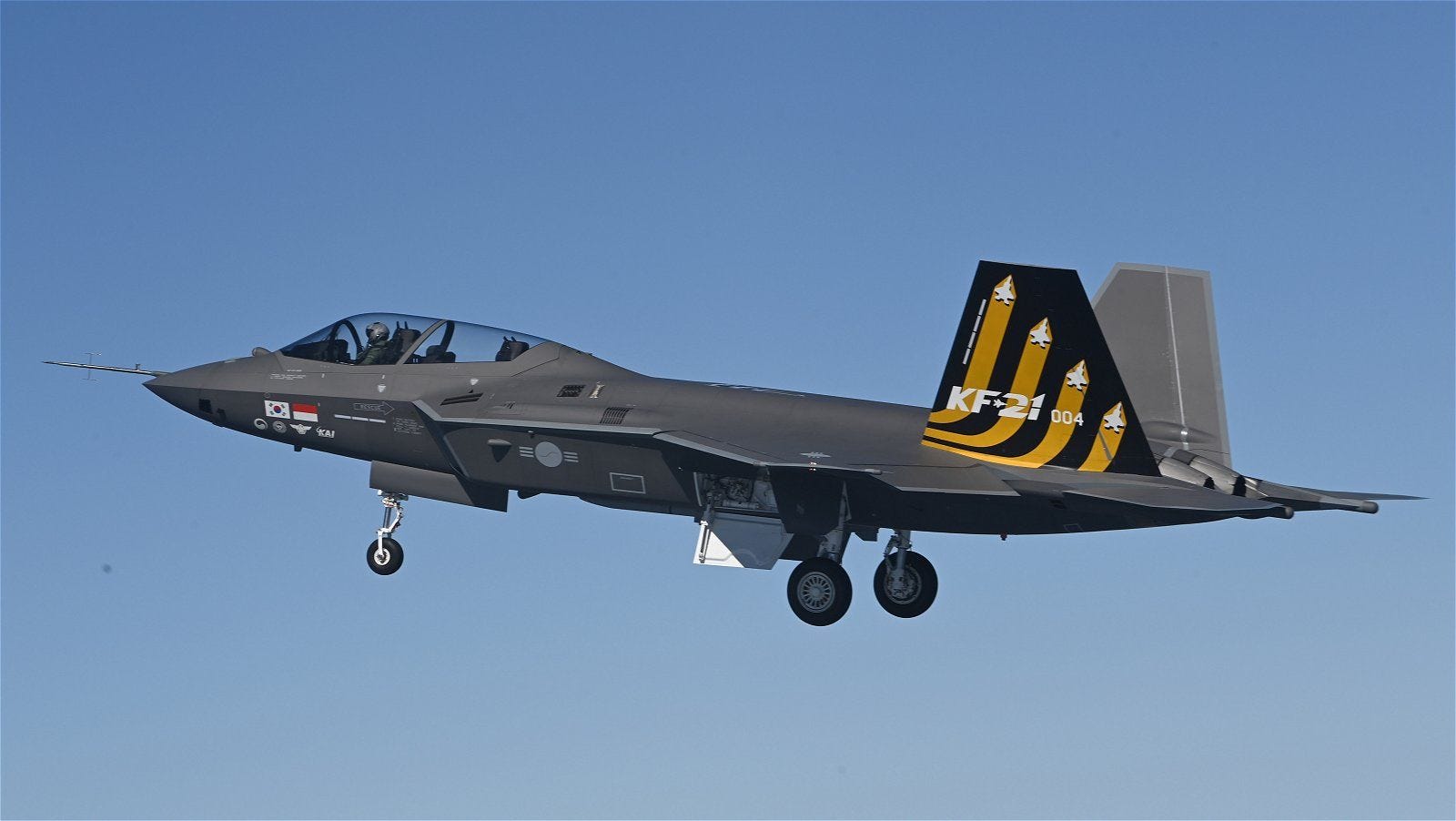
Hanwha Aerospace is the sole-source domestic licensed assembler of the GE F414 engines that power the KF-21 Boramae, Korea’s indigenous 4.5-generation fighter.
The first production aircraft rolled out of KAI’s Sacheon facility in March 2026 and completed its maiden flight in April 2026.
The engine assembly relationship with GE Aerospace also covers F404 turbofans for the FA-50 light fighter and T700 turboshafts for KUH-1 Surion and Light Armed Helicopter applications.
In late 2025, Hanwha signed an additional agreement covering 88 T700 kits and 40 F404 kits to power KAI-built rotorcraft and trainers.

The most ambitious initiative is the USD 3.4 billion indigenous engine program announced in 2025, in which Hanwha leads development of a 15,000 to 16,000-pound thrust class fighter engine.
Targeting initial deliveries by the late 2030s, this becomes one of the most ambitious sovereign aviation propulsion projects outside the United States, China, Russia and Western Europe.
KF-21 PROPULSION ROADMAP

Block 1 (2026 IOC)   - GE F414-GE-400K (licensed by Hanwha)
Block 2 (post 2028)  - Air-to-ground capable, same engine
Block 3 (2030s)      - Stealth-shaping refinements,
                       transition window for indigenous engine
Indigenous engine    - 15,000-16,000 lbf, target IOC late 2030s
                       Lead system integrator: Hanwha Aerospace
Funding: 3.35 trillion won (DAPA)Aircraft Engine MRO and Components Business
Beyond the high-profile fighter and helicopter work, Hanwha Aerospace is one of the largest commercial aero-engine component suppliers in Asia.
The company supplies turbine and structural parts to all three “big three” engine OEMs, manufacturing components for the GE LEAP family, Pratt & Whitney’s GTF, and Rolls-Royce’s Trent series.

A USD 1 billion Rolls-Royce contract for turbine components is being executed primarily out of the Vietnam plant complex, where Hanwha has expanded into a third facility to add capacity.
The site is increasingly central to the company’s commercial aerospace exposure and ties it directly to the global narrow-body recovery cycle.
This commercial aerospace book offsets the lumpiness of defense order intake by providing recurring revenue tied to airline traffic.
With the global commercial fleet replacement cycle still mid-stream, the segment offers underappreciated stability inside what is otherwise perceived as a pure defense story.
Naval Gas Turbines and Maritime Systems
In the maritime domain, Hanwha Aerospace produces naval gas turbines under license from GE Aerospace, primarily LM2500 variants powering the Korean Navy’s frigates and destroyers.
In 2025, the two companies signed a memorandum of understanding to jointly develop a next-generation naval gas turbine, raising ambitions from licensed assembly to genuine co-design.
This positions Hanwha to extract more value from the global naval modernization wave, where countries from the Philippines and Indonesia to Poland are building out blue-water fleets.
The MASGA framework with the United States adds a significant commercial growth lane, especially when combined with the Philly Shipyard and Austal industrial assets.
Space, Launch and Satellite Solutions
Hanwha Aerospace’s space ambitions crystallized in 2025 when Korea Aerospace Research Institute (KARI) signed a landmark full technology transfer agreement for the Nuri (KSLV-II) launch vehicle. The transfer is the most consequential industrial event in Korean space history because it makes Hanwha the country’s first private prime for orbital launch.
The Nuri completed its fourth flight in late 2025, with two additional launches scheduled by 2027. The transfer brings full system architecture authority to Hanwha, including the 75-tonne and 7-tonne KRE engines that propel the three-stage rocket to low Earth orbit.
On the satellite side, Satrec Initiative successfully launched SpaceEye-T in March 2025, a 700kg high-resolution Earth observation platform capable of distinguishing 30cm objects. SpaceEye-T’s ultra-high resolution puts the company in direct conversation with global commercial imagery providers.
Missile Defense: L-SAM and Cheongung Family
In December 2025, Hanwha Aerospace was awarded an additional USD 480 million contract covering the next batch of L-SAM long-range surface-to-air missile systems for the Republic of Korea Air Force. The L-SAM is South Korea’s first indigenous missile defense system designed to intercept ballistic threats at high altitude.
Combined with the medium-range Cheongung KM-SAM Block II already exported to the United Arab Emirates, Saudi Arabia and Iraq, the L-SAM gives Korea a layered air-defense package that is increasingly cited by Middle Eastern and European buyers as a credible alternative to Patriot, SAMP/T or S-400 packages.
The export-relevant component for Hanwha Aerospace is the missile body, propulsion stack and launch vehicle, while Hanwha Systems contributes the multi-function AESA radar. The two together form a vertically integrated air-defense package across the group.
Financial Analysis: Hanwha Aerospace
Top-Line Trajectory: From KRW 11 Trillion to KRW 26 Trillion in One Year
The most arresting feature of Hanwha Aerospace’s recent financial profile is the speed of revenue scaling. Full-year 2025 revenue reached approximately KRW 26.6 trillion, a 137% jump over 2024 and roughly triple the 2023 print.
That growth was overwhelmingly driven by the ground-defense division, where deliveries to Polish, Egyptian and Romanian customers ramped concurrently.
Operating profit rose to KRW 3.03 trillion, a 75% year-on-year increase, with ground defense alone contributing a record KRW 2.01 trillion of operating profit.
HANWHA AEROSPACE CONSOLIDATED RESULTS (KRW)

FY 2023 Revenue:    ~9.4 trillion
FY 2024 Revenue:    ~11.2 trillion
FY 2025 Revenue:    26.6 trillion  (+137% YoY)

FY 2024 Op. Profit: ~1.73 trillion
FY 2025 Op. Profit: 3.03 trillion (+75% YoY)

FY 2024 Net Profit: ~2.54 trillion
FY 2025 Net Profit: 2.14 trillion (-15.7% YoY)

Ground-Defense Op. Profit FY25: 2.01 trillion (record)
Source: Company regulatory filings, Feb 2026
The revenue scaling is real, but the net-profit decline is worth confronting head-on.
Despite the massive operating-profit step-up, net profit fell by approximately 16% due to a combination of higher financial expenses tied to the capital raise, currency-related items, and the dilution effect of newly issued shares.
Quarterly Cadence and the 4Q 2025 Miss
The third quarter of 2025 was a record by virtually every metric: sales of KRW 6.5 trillion (up 146.5% YoY) and operating profit of KRW 856.4 billion (up 79.5%). The fourth quarter, however, missed consensus operating-profit estimates by roughly 36%.
The market reacted negatively, with analysts flagging that one-time provisioning, mix shift toward lower-margin Polish K9 deliveries and end-of-year cost recognition all weighed on the print.
Notably, the underlying ground-defense backlog continued to expand, suggesting the issue is one of timing rather than demand.
QUARTERLY OPERATING PROFIT (KRW Billion, approx.)

1Q25:  ~600
2Q25:  ~880  (record at the time)
3Q25:  856.4 (new record)
4Q25:  ~700  (below consensus by ~36%)

Full year: 3,034 billion
Direction: Lumpy, as expected for project-based delivery firms.
Segment Composition
By divisional breakdown, ground defense (the K9 / K10 / Chunmoo / Redback complex) accounted for the dominant share of both revenue and profit in 2025. Aviation propulsion, satellite, and other businesses contributed materially smaller, though faster-growing, slices.
The company’s reporting structure has evolved to highlight the Defense Sector and Aerospace Sector separately, with sub-segments for Marine, Aviation and Aerospace Division, IT Service and Power System businesses.
This more granular reporting will help analysts track the structural shift toward aviation propulsion through 2028 to 2030.
Backlog: The Multi-Year Visibility Anchor
The most strategically important number in the entire Hanwha Aerospace investment thesis is backlog.
By the end of 2025, the ground-defense backlog alone reached 37.22 trillion won, implying multiple years of forward revenue visibility before counting any new wins.
Adjacent group companies also boast healthy books, with Hanwha Systems carrying around 9.3 trillion won in defense backlog.
Combined, the group entered 2026 with one of the most robust order pipelines in the global defense industry, second only to a handful of U.S. and European primes by absolute size.
ORDER BACKLOG SCORECARD (END OF 2025)

Hanwha Aerospace ground defense:  37.22 trillion KRW
Hanwha Systems defense:            9.30 trillion KRW
Combined Hanwha defense backlog:  ~46.5 trillion KRW
                                  (~USD 32+ billion)

Implied revenue visibility (defense): roughly 3-5 years
based on current quarterly delivery cadence.Capital Structure and Shareholder Returns
The 2025 capital raise reduced the size of the offering from the originally announced KRW 3.6 trillion to roughly KRW 2.3 trillion, and the group’s affiliates committed to absorbing approximately KRW 1.3 trillion of newly issued shares directly.
Proceeds are funding KF-21 engine development, Romanian and U.S. capacity expansion, and the Austal stake increase.
The company’s first formal “Value-Up” plan, published on the Korean exchange in June 2025, set out shareholder return commitments and capital-allocation priorities.
While reception was mixed, with corporate governance critics flagging the capital-raise governance as imperfect, the plan formalized a shift toward routine dividend communication and buyback discipline.
Liquidity, Leverage and Return Metrics
Hanwha Aerospace ended 2025 with materially expanded working-capital requirements due to advance payments on long-term defense contracts and inventory build-up at Polish, Romanian and Vietnamese facilities. Net debt is offset by sizable cash and cash-equivalent positions tied to milestone billings.
Return on equity is volatile but trending higher on operating leverage, with consensus estimates implying that, even after the 2025 capital raise dilution, the company’s mid-term ROE could land in the mid-teens through 2027 to 2029 if delivery execution holds.
Revenue and Growth Drivers Through 2026 and Beyond
Driver 1: European Rearmament Cycle
The single most important macro driver for Hanwha Aerospace remains the European rearmament cycle, which is structurally rather than cyclically driven. NATO members are committing to higher defense spending floors, and European defense industries cannot meet demand on their own.
Hanwha has filled this gap with a credible value proposition: short delivery times, NATO-standard ammunition compatibility, willingness to license production, and strong financing options through the Korean ExIm framework. This is why Poland, Romania, Norway, Finland, the United Kingdom and Estonia have all become customers within five years.
Romania’s EUR 1.3 billion industrial package announced in March 2026 represents a new template: not just selling equipment, but building local production sovereignty in partnership with the host nation. This is the model that allows Hanwha to defend its European market share against eventual European primes ramping production.
Driver 2: U.S. Naval and Industrial Footprint
The MASGA strategy and the USD 5 billion Philly Shipyard investment plan position Hanwha as one of the few foreign players with credible production capacity inside the United States.
This is consequential because U.S. shipbuilding capacity remains a structural national security concern that Washington is willing to subsidize.
Hanwha’s first U.S. Navy contract under the MASGA push, secured in early 2026, signals that the strategy is bearing fruit. Combined with the Austal stake increase, the company now has access to shipyards on both U.S. coasts and into Australia.
Driver 3: Indigenous Aviation Propulsion Build-Out
The KF-21 series production ramp through 2026 to 2032 is the next major aviation revenue driver. Each aircraft requires twin F414 engines, with deliveries scheduled to extend through the entire production run of 120 aircraft for the Korean Air Force.
Beyond licensed F414 work, the USD 3.4 billion indigenous engine program creates a durable revenue stream stretching into the 2040s. Sovereign engines are a multi-decade industrial commitment, not a project, and they generate downstream MRO economics for the life of the fleet.
Driver 4: Space Commercialization
The Nuri technology transfer makes Hanwha a private launch operator in a market where commercial demand is rising.
Two further launches are scheduled by 2027, with Hanwha increasingly responsible for launch-services delivery.
Meanwhile, the 40-satellite SAR constellation contest for the Korean military, valued around USD 850 million, gives Hanwha Systems and KAI a marquee piece of business to compete for.
Driver 5: Commercial Aero MRO and Engine Components
Although less headline-grabbing than fighter jets and self-propelled howitzers, the commercial aircraft engine components business provides a counter-cyclical anchor.
With Vietnam plant capacity expanding for Rolls-Royce Trent work plus existing GE LEAP and Pratt & Whitney GTF supply, Hanwha is positioned to ride the global narrow-body and wide-body fleet renewal.
GROWTH DRIVER MATURITY MATRIX (2026-2032)

Driver                  Maturity      Margin Profile
European K9/Chunmoo     Scaling       High (mature platform)
KF-21 F414 assembly     Scaling       Moderate (licensed)
US shipyard / MASGA     Emerging      Below segment avg.
Indigenous engine       Investing     Long-term high
Space launch services   Emerging      Capital-intense
Commercial engine MRO   Mature        Steady
Missile defense (LSAM)  Scaling       Premium
Driver 6: Local Production and Industrial Cooperation Packages
Hanwha is increasingly winning programs by offering host-country production packages.
The Romanian deal includes a groundbreaking factory for K9 production. India already builds the K9 Vajra-T under license with Larsen & Toubro. Egypt, Australia and Poland include local content commitments.
This trend protects market share against future European or U.S. competitors and creates politically embedded supply chains. It does, however, dilute near-term margin per unit, a deliberate trade-off of long-term defensibility for short-term unit economics.
Major Competitors and Comparative Analysis
Hanwha Aerospace Competitor Universe
The competitor set spans land, air, space and missile defense, and varies by program. The most consistent peers across the broadest portfolio overlap include:
BAE Systems plc (United Kingdom)
Rheinmetall AG (Germany)
Elbit Systems Ltd (Israel)
General Dynamics Corporation (United States)
Lockheed Martin Corporation (United States)
KNDS (France/Germany)
Mitsubishi Heavy Industries (Japan)
Korea Aerospace Industries (KAI) (Korea, ally and competitor)
China North Industries Group (NORINCO, indirectly through global tenders)
Israel Aerospace Industries (IAI)
Saab AB (Sweden)
GE Aerospace (United States, partner and competitor in propulsion)
Hanwha Aerospace vs. Rheinmetall AG
Rheinmetall is the closest like-for-like competitor in artillery and armored vehicles. The German firm’s PzH 2000 self-propelled howitzer and Lynx IFV directly compete with the K9 and AS-21 Redback in NATO procurements.
Hanwha’s structural advantage comes from production capacity and lead times. While Rheinmetall has historically priced at a premium and faced multi-year backlogs, the K9 platform is delivered in months because of Korean industrial scale and proven serial production.
HANWHA vs. RHEINMETALL: HEAD-TO-HEAD

Artillery:           K9 vs. PzH 2000
                     - Hanwha won UK, Norway, Romania, Finland
                     - Rheinmetall holds German, Italian, Hungarian
                     - K9 ~60% global mobile artillery share

IFV:                 AS-21 Redback vs. Lynx KF41
                     - Hanwha won LAND 400 Phase 3 (Australia)
                     - Rheinmetall won Hungarian and Italian programs
                     - Verdict: Split market, regional preferences

Air defense:         L-SAM/Cheongung vs. Skynex/HX
                     - Hanwha primarily competes in mid-tier exports
                     - Rheinmetall stronger in counter-UAS niche

Verdict: Direct competitors with near-symmetric capability,
         differentiated mostly on price and delivery timelines.
Rheinmetall’s recent financial performance has been similarly strong, but its lower production capacity at the high end has often forced European customers to look East.
Hanwha’s response has been to build local production in Europe to neutralize Rheinmetall’s home-field advantage.
Hanwha Aerospace vs. BAE Systems
BAE Systems’ Archer self-propelled howitzer (acquired through the BAE Bofors line) and AS90 fleet compete with the K9 in artillery procurements. Industry analysts have explicitly described Hanwha as the most dangerous competitor to BAE’s land business in 2026.

BAE retains a significant edge in submarines, naval combat systems and electronics, areas where Hanwha competes only indirectly through Hanwha Systems and the new Austal-Philly Shipyard footprint. BAE’s depth in U.S. defense procurement gives it home-market protection that Hanwha cannot easily replicate.
The pivotal contest of 2025 to 2026 was the British Army’s Mobile Fires Platform competition, which selected the K9A2. This was a strategically important loss for BAE and a vote of confidence in Hanwha by one of the most demanding NATO procurement establishments.
Hanwha Aerospace vs. Lockheed Martin
Lockheed Martin is a less direct competitor, but the head-to-head emerges in MLRS systems where Lockheed’s HIMARS competes with Hanwha’s Chunmoo. Norway’s choice of Chunmoo over HIMARS marked the most visible defeat of HIMARS in a major NATO procurement.
Lockheed retains decisive advantages in fifth-generation aviation (F-35), strategic missile defense (THAAD, Aegis BMD), and space systems. Hanwha is not directly competing for those programs; rather, Hanwha increasingly partners with U.S. system primes as a sub-tier industrial supplier.
The relationship is, in practice, more complementary than competitive. Hanwha buys F404, F414 and T700 cores from GE Aerospace and integrates with U.S. mission systems on Korean platforms. The competition emerges only in third-country tenders.
Hanwha Aerospace vs. General Dynamics
General Dynamics’ Land Systems business produces the M109 Paladin self-propelled howitzer, which has lost ground to the K9 in multiple NATO comparison evaluations.

The M1A2 Abrams main battle tank does not compete with Hanwha-built platforms directly, since Korea sources tanks from Hyundai Rotem rather than Hanwha.
General Dynamics holds dominant U.S. submarine and shipbuilding positions, where Hanwha is now positioning to enter via Philly Shipyard and Austal. The MASGA framework explicitly contemplates Hanwha-built logistics ships and auxiliaries to relieve pressure on U.S. yards.
Hanwha Aerospace vs. Korea Aerospace Industries (KAI)
The relationship with KAI is the most nuanced in the company’s competitive map. The two firms are jointly executing the KF-21, the Surion helicopter program, and a multi-decade indigenous fighter and rotorcraft roadmap.
In February 2026, the two companies signed an unprecedented joint partnership covering future unmanned aircraft, advanced engine development, and entry into selected international markets. This converts what was previously a complex co-opetition relationship into a structured alliance.
That said, the two firms compete head-on in satellite and space programs, where the SAR constellation tender places Hanwha Systems against KAI’s satellite division. The two firms also vie for primacy in the future autonomous combat aircraft program.
Hanwha Aerospace vs. Elbit Systems
Elbit competes most directly in unmanned systems, electronics, and modernization packages.
Both firms are active in the same export markets, including Eastern Europe, Southeast Asia and Latin America, and increasingly bid against each other for upgrade contracts.
Elbit has a structural advantage in combat-proven systems, particularly UAS and electronic warfare suites. Hanwha’s advantage is in industrial scale and turnkey heavy systems, especially when bundled with financing and licensed production. The two are likely to coexist comfortably in most markets through 2030.