


Welcome to AviationOutlook: The aviation newsletter built exclusively for decision-makers.
Become an “Annual” member now & get this special discount offer.
As a paid member, you get access to:
200+ Reports - All major airlines + aerospace & defense companies (updated regularly).
Daily / Weekly - Deep-dive analysis & insights.
Monthly - Industry outlook reports.
In case you missed it, here are the latest analysis reports:
Embraer - Company Analysis and Outlook Report 2026 (Updated)
American Airlines’ Six-Route Europe Play: Yield Discipline or Widebody Overreach?
Check Out All Reports
Executive Summary
Philippine Airlines closed 2025 with a net income of USD 160.4 million, a 6.1 percent increase year-on-year, on total revenues of USD 3.22 billion, marking its 16th consecutive profitable quarter under a sustained post-restructuring growth trajectory.
The flag carrier became Southeast Asia’s first operator of the Airbus A350-1000 in December 2025, anchoring a 22-aircraft delivery pipeline that includes nine A350-1000s and 13 A321neos for transpacific and regional growth.
PAL is expanding aggressively in the U.S. market, with the Manila-Chicago nonstop launch on November 9, 2026, becoming its eighth U.S. destination, while increasing Manila-Los Angeles frequencies from 14 to 18 weekly flights starting June 1, 2026.
The carrier is targeting a fleet expansion from 82 aircraft to 90 by the end of 2026, supported by a fleet renewal program, the appointment of British turnaround specialist Richard Nuttall as President in May 2025, and ongoing reorganization of regional hubs in Cebu, Clark, and Davao.
Recommended - Read Full Reports


Read All Reports
Table of Contents
Executive Summary
Philippine Airlines Company Profile: Key Facts
Philippine Airlines Revenue and Financial Analysis
2025 Full-Year Financial Performance
Q2 and Q3 2025 Quarterly Performance Detail
Balance Sheet, Liquidity, and Capital Structure
Revenue Growth Drivers in 2025 and 2026
Key Services and Products
Philippine Airlines Fleet Analysis
Mainline Fleet Size and Composition
Aircraft Types and Strategic Configuration
The A350-1000 Flagship and Long-Haul Strategy
Narrowbody Fleet and the A320 Family Renewal
PAL Express and the Turboprop Fleet
Fleet Renewal Strategy and Sustainability Roadmap
Philippine Airlines Route Network Strategy and Major Destinations
Network Footprint Overview
Transpacific and North America Strategy
Asian and Northeast Asia Hubs
Middle East and South Asia
Australia and Pacific Strategy
Domestic Network
New Routes and 2026 Expansion Map
Major Operational Bases and Hubs
Manila Ninoy Aquino International Airport (NAIA)
Mactan-Cebu International Airport
Clark International Airport
Davao International Airport
Philippine Airlines Competitive Position
Major Competitors at a Glance
Philippine Airlines vs Cebu Pacific Air
Philippine Airlines vs AirAsia Philippines
Philippine Airlines vs Singapore Airlines
Philippine Airlines vs Cathay Pacific
Philippine Airlines vs Emirates, Qatar Airways, and Etihad
Philippine Airlines vs U.S. Carriers on Transpacific
Codeshare and Alliance Strategy
Regulatory, Safety, and Operational Excellence
Safety Certification
On-Time Performance
Sustainability and ESG Posture
Digital Transformation and Customer Experience
Cargo Strategy
Maintenance, Repair, and Overhaul (MRO) Partnerships
Workforce and Operational Footprint
Industry Context: Philippine Aviation in 2025-2026
Recent Corporate Developments
Leadership Transition
Capital Markets Activity
Key Risks Facing Philippine Airlines
Risk 1
Risk 2
Risk 3
Risk 4
Risk 5
Risk 6
Risk 7
Risk 8
Outlook for 2026 and Beyond
My Final Thoughts
Official Sources and Data
Philippine Airlines Company Profile: Key Facts
Philippine Airlines is the national flag carrier of the Republic of the Philippines and the oldest commercial airline in Asia still operating under its original name.
The airline traces its founding to February 26, 1941, making it 85 years old as of the 2026 calendar year and one of the longest continuously operating air carriers in the Asia-Pacific region.
PAL’s parent holding company, PAL Holdings, Inc., is publicly listed on the Philippine Stock Exchange under the ticker symbol “PAL.” The airline is part of the broader business empire of Filipino-Chinese billionaire Lucio Tan, with ultimate beneficial control held through Trustmark Holdings Corporation and related entities within the LT Group ecosystem.
Headquartered at the PNB Financial Center in Pasay City, Metro Manila, the carrier operates from its principal hub at Ninoy Aquino International Airport (NAIA) Terminal 2.
Secondary operational bases are located at Mactan-Cebu International Airport, Clark International Airport, and Francisco Bangoy International Airport in Davao City.
PAL at a Glance (2026)
-----------------------------------
Founded: February 26, 1941
Headquarters: Pasay City, Philippines
Parent: PAL Holdings, Inc. (PSE: PAL)
Controlling Shareholder: Lucio Tan family group
President: Richard Nuttall (since May 29, 2025)
PAL Holdings President: Lucio Tan III
Stock Symbol: PAL (Philippine Stock Exchange)
Fleet (active): 50 mainline + PAL Express
IATA Code: PR | ICAO Code: PAL
Loyalty Program: Mabuhay Miles
Skytrax Rating: 4-Star Airline
APEX Rating: Four Star Major AirlineThe airline holds a 4-Star Skytrax certification for cabin product, catering, and ground service quality.
PAL also carries an APEX Four Star Major Airline designation and was named the Asia-Pacific region’s most punctual airline in April 2025 by aviation analytics firm Cirium, having ranked among the top ten globally for two consecutive years prior.
The airline is currently led by President Richard Nuttall, a British national and former Chief Executive Officer of SriLankan Airlines, who took the top operational role on May 29, 2025. His appointment marked the first time a non-Filipino has led the flag carrier in its 85-year history. His predecessor, Captain Stanley Ng, moved upward to PAL Holdings, Inc. as part of a broader leadership refresh.
PAL operates as a full-service network carrier and is the only such carrier headquartered in the Philippines.
Its regional subsidiary, PAL Express, supports inter-island services using a mixed jet and turboprop fleet, allowing the parent airline to focus mainline jet capacity on higher-density domestic and international routes.

Philippine Airlines Revenue and Financial Analysis
2025 Full-Year Financial Performance
PAL closed the fiscal year 2025 with total revenues of USD 3.22 billion, up roughly 3 percent from USD 3.13 billion in the previous year.
Net income for the year reached USD 160.4 million, representing a 6.1 percent improvement over 2024 and underscoring the maturing of the airline’s post-rehabilitation business model.
Passenger operations remained the dominant revenue line, generating USD 2.73 billion across the year. The carrier transported 16.3 million passengers in 2025, a 4.3 percent year-on-year increase that was achieved despite an industry-wide softening of international yields.
Operating expenses rose 6.3 percent to nearly USD 3 billion, reflecting higher maintenance spend, structural cost pressures linked to airport charges in Manila, and incremental costs from the introduction of new aircraft types into the fleet.
PAL Full-Year 2025 Highlights
-----------------------------------
Total Revenue: USD 3.22 billion (+3.0% YoY)
Net Income: USD 160.4 million (+6.1% YoY)
Passenger Revenue: USD 2.73 billion
Passengers Carried: 16.3 million (+4.3% YoY)
Operating Expenses: ~USD 3.0 billion (+6.3% YoY)
Capital Expenditure (1H 2025): USD 300 millionQ2 and Q3 2025 Quarterly Performance Detail
The second quarter of 2025 was particularly strong.
PAL booked a net income of USD 60 million for the three months ended June 30, 2025, a 48 percent year-on-year jump that marked the airline’s 15th straight profitable quarter.
Total revenues for the quarter reached USD 831 million, a 6 percent improvement, while operating income improved 10 percent to USD 71 million.
Third-quarter performance built on this momentum. The flag carrier reported a 62 percent year-on-year increase in net income to USD 22 million for the three months ended September 30, 2025, supported by tight cost control during the seasonally weaker September quarter.
PAL’s first-half 2025 net income closed at USD 137 million, up 12 percent year-on-year, with operating income of USD 146 million.
The airline operated 57,598 flights during the first six months and transported 8.47 million passengers, gains of 2 percent and 7 percent respectively over the prior-year comparable period.
Balance Sheet, Liquidity, and Capital Structure
PAL strengthened its balance sheet meaningfully through 2025.
Total debt and long-term financial obligations were reduced to USD 1.39 billion as of June 30, 2025, down from USD 1.57 billion a year earlier.
Cash and cash equivalents stood at USD 455 million at the end of the second quarter, and total assets reached USD 3.8 billion against total liabilities of USD 2.9 billion.
Total equity climbed to USD 922 million as of June 30, 2025, up from USD 785 million at the end of 2024.
This expanded equity base provides headroom for the airline’s calibrated growth plan, including the multi-year aircraft delivery schedule that requires substantial pre-delivery payment commitments.
Capital expenditure for the first six months of 2025 totaled USD 300 million, fully covered by cash from operations. These outlays were primarily directed toward pre-delivery payments on aircraft on order and major airframe and engine maintenance activities.
Revenue Growth Drivers in 2025 and 2026
Several structural drivers explain PAL’s revenue trajectory.
The airline’s international passenger volumes have expanded with the addition of new transpacific frequencies and the gradual restoration of long-haul widebody capacity that was previously rationalized during the COVID-era restructuring.
Cargo revenue grew by USD 2 million in Q2 2025 alone as PAL carried 51,200 tons of cargo, a 13 percent year-on-year increase. The new Manila-Chicago nonstop launch is expected to add up to 60 tons per week of cargo capacity across its U.S. network, further reinforcing PAL Cargo’s role as a meaningful contributor to overall margins.
Revenue Mix Snapshot 2025
-----------------------------------
Passenger Revenue:        ~USD 2.73 billion
Cargo Revenue:            Mid-single digit % share
Ancillary & Other:        Growing ~mid teens YoY
Loyalty (Mabuhay Miles):  Embedded in passenger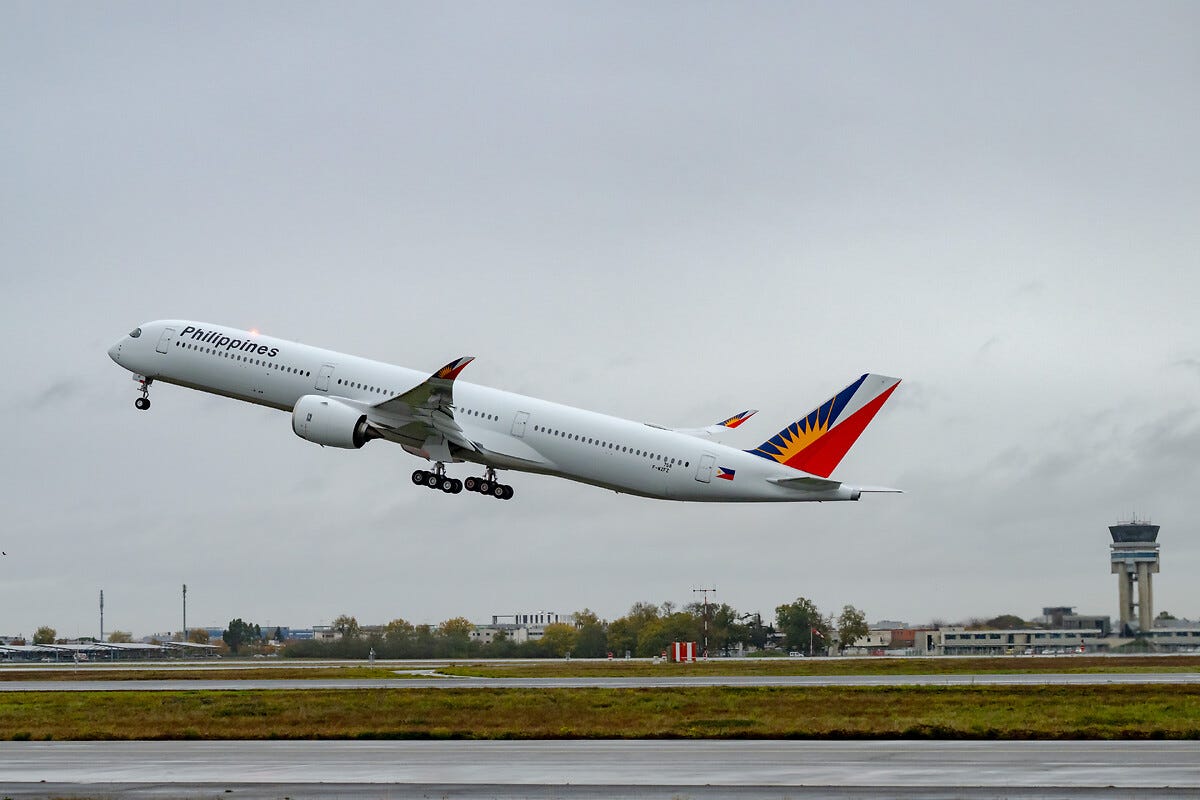
Key Services and Products
The airline operates a full-service three-cabin product on most widebody equipment.
Business Class on the new A350-1000 features lie-flat suites with direct aisle access, while the A350-900 and Boeing 777-300ER fleets offer competitive forward cabin products on high-density transpacific and intra-Asia sectors.
Premium Economy was introduced on the A350-900 fleet and has been extended to the A350-1000 configuration that entered service in late December 2025. This three-cabin layout is one of the differentiating features versus low-cost competitors at home and the older two-cabin products of certain regional rivals.
PAL Cargo, the airline’s freight division, operates as a belly-hold cargo provider across the entire network and offers specialized services such as Rush Cargo, perishable handling, and live animal logistics. The cargo terminal at Manila was recently relocated to a new dedicated facility to expand processing throughput.
The Mabuhay Miles loyalty program is the airline’s primary customer retention tool. Active codeshare partnerships and frequent flyer reciprocity arrangements with Alaska Airlines, American Airlines, Etihad Airways, Qatar Airways, Cathay Pacific, and Japan Airlines provide significant value to elite tier members beyond PAL’s own metal.
Philippine Airlines Fleet Analysis
Mainline Fleet Size and Composition
Philippine Airlines operates one of the more diverse fleets among Southeast Asia’s full-service flag carriers, with both Airbus and Boeing widebodies and Airbus narrowbodies.


The mainline fleet stood at 50 active aircraft as of the start of 2026, with the airline targeting an expansion to 90 aircraft across the broader group by the end of 2026.
The current mainline fleet composition is built around five primary types: the Airbus A321ceo, Airbus A321neo, Airbus A330-300, Airbus A350-900, Airbus A350-1000, and Boeing 777-300ER.
Each aircraft type has been deliberately matched to specific mission profiles within the international and domestic networks.
PAL Mainline Active Fleet (Early 2026)
-----------------------------------
Airbus A321-200 (ceo):       18
Airbus A321neo:               8
Airbus A330-300:             11
Airbus A350-900:              2
Airbus A350-1000:             1
Boeing 777-300ER:            10
-----------------------------------
Active Mainline Total:       50
On Order:                    21
  -- A350-1000:               8
  -- A321neo:                13
The average mainline fleet age across PAL was approximately 11.5 years at the start of 2026, according to public fleet tracking, with the imminent A350-1000 deliveries expected to bring this number down meaningfully through 2027 as older A321ceo and A330-300 frames are retired or repurposed.
Aircraft Types and Strategic Configuration
The Boeing 777-300ER fleet, comprising ten frames, has historically served as the workhorse for ultra-long-haul transpacific flying to Los Angeles, San Francisco, New York, and Vancouver.
These aircraft are configured with 370 seats in a two-cabin layout, with 42 Business Class suites and 328 Economy seats, providing high passenger throughput on dense U.S. routes.
The Airbus A350-900 fleet of two aircraft introduced PAL’s first three-cabin long-haul product, including Premium Economy. These aircraft launched the New York nonstop route, the Toronto service, and seasonal capacity into key transpacific markets, and they have proven particularly effective on routes where pure 777-300ER capacity would have been excessive.
The Airbus A330-300 fleet of eleven aircraft serves as PAL’s regional widebody backbone, deployed on heavy intra-Asian sectors such as Tokyo, Osaka, Sydney, Melbourne, and Hong Kong, alongside selected high-yield domestic trunk routes such as Manila to Cebu and Manila to Davao during peak periods.
The A350-1000 Flagship and Long-Haul Strategy
The introduction of the Airbus A350-1000 is the centerpiece of PAL’s long-haul fleet strategy through 2030. The airline took delivery of its first frame, registered RP-C3508, on December 22, 2025, becoming the 10th airline worldwide and the first carrier in Southeast Asia to operate the variant.
The A350-1000 is configured in a premium three-class layout with 382 seats, comprising lie-flat Business Class suites, a sizable Premium Economy cabin, and an updated Economy product with 4K seatback in-flight entertainment screens, fast Wi-Fi connectivity, and Bluetooth audio pairing.
PAL has committed to a total of nine A350-1000s, with five scheduled for delivery during 2026 and the remaining three arriving in 2027. The aircraft inaugurated revenue service on regional routes from December 30, 2025, before transitioning to the New York nonstop route starting January 6, 2026.
A350-1000 Configuration Snapshot
-----------------------------------
Total Seats:                   382
Business Class:           Lie-flat
Premium Economy:           Cabin
Economy:                Refreshed
Engines:                 RR Trent XWB-97
SAF Capability:                Up to 50%
Long-haul Range: TranspacificNarrowbody Fleet and the A320 Family Renewal
The narrowbody fleet is undergoing a parallel transformation. The Airbus A321ceo fleet of 18 aircraft is being progressively refurbished, with the first of 18 retrofitted A321ceos entering service in October 2025, featuring upgraded cabins, refreshed in-flight entertainment, and Wi-Fi connectivity.
Eight Airbus A321neo aircraft are currently in service, with thirteen additional units on firm order from Airbus. These aircraft serve a combination of short-range and long-range A321neo missions, including specialized A321neo Long-Range frames that operate sectors as far as Brisbane and Sapporo from Manila.
In December 2025, the airline announced an order for five additional Airbus A320s worth USD 490 million, which will be deployed primarily on domestic trunk routes. One A320 was scheduled to enter service before the end of 2025, with three more joining the fleet during 2026 and the final unit arriving thereafter.
PAL Express and the Turboprop Fleet
PAL Express, the regional subsidiary that operates under the parent’s IATA code and feeds the broader network, maintains a separate but coordinated fleet. The unit operates a mix of Airbus A320-200, Bombardier/De Havilland Canada Dash 8 Q400, Q400NG, and DHC-8-300 aircraft.
The 86-seater Dash 8-400NG turboprops are uniquely well-suited to many of the smaller Philippine inter-island airports, where runway length of less than 1.5 kilometers prevents jet operations. This makes the turboprop fleet a strategic asset rather than a legacy holdover, as it underpins the airline’s national connectivity proposition.
In October 2025, the parent airline realigned turboprop operations to shift more turboprop services out of Manila and into Clark and Cebu, with simultaneous expansion of mainline jet services on trunk domestic routes such as Manila to Cebu, Manila to Iloilo, and Manila to Dumaguete.
Fleet Renewal Strategy and Sustainability Roadmap
The fleet renewal program is built around three objectives: capacity growth, fuel efficiency improvement, and unit cost reduction. The new-generation A350-1000 and A321neo families both deliver roughly 25 percent fuel burn advantages over previous-generation comparable aircraft, supporting both margin expansion and sustainability targets.
Both Airbus types in the order book are already certified to operate on up to 50 percent Sustainable Aviation Fuel (SAF), with the airframer targeting full 100 percent SAF capability by 2030. This positions PAL to comply with emerging regulatory requirements such as ICAO’s CORSIA framework with relatively limited incremental investment.
A renewed long-term engine maintenance partnership with Lufthansa Technik underpins fleet reliability. Lufthansa Technik Philippines, a joint venture between Lufthansa Technik AG and the locally listed MacroAsia Corporation, provides line and base maintenance for the Airbus fleet at Manila, with the broader collaboration crossing 25 years in 2025.