


Executive Summary
Rocket Lab Corporation closed fiscal 2025 with record revenue of $602 million, 38% growth year over year, while ending the year with a $1.85 billion backlog that grew 73% from the prior year, providing the clearest revenue visibility in the company’s history as it heads into 2026.
The company has transformed from a small launch specialist into a vertically integrated prime contractor for U.S. national security space, anchored by the $816 million Tranche 3 Tracking Layer award from the U.S. Space Development Agency in December 2025 and a prior $515 million Transport Layer-Beta Tranche 2 contract.
Neutron, the medium-lift partially reusable rocket and Rocket Lab’s most consequential program, slipped to a Q4 2026 inaugural launch after a Stage 1 propellant tank ruptured during testing in January 2026, but engine and fairing qualification milestones remain on schedule at NASA’s Stennis Space Center.
Two major acquisitions in 2025 and 2026, Geost for $275 million (sensor payloads) and Mynaric for $155.3 million (laser optical communications), give Rocket Lab in-house control over two of the most constrained subsystems in defense and commercial constellations.
Recommended - Read Full Reports


Read All Reports
Table of Contents
Executive Summary
Key Facts: Rocket Lab Company Profile
Rocket Lab Company Overview
A Two-Decade Climb From Auckland Garage to Defense Prime
Corporate Structure and Reporting Segments
Headcount and Manufacturing Footprint
Key Product Lines, Programs, and Services
Electron: The World’s Most Frequently Launched Small Orbital Rocket
HASTE: A Defense-Class Variant That Is Now a Standalone Business
Neutron: The Medium-Lift Reusable Rocket That Will Define the Next Decade
Archimedes Engine and the Stennis Test Campaign
Photon and the Lightning Bus: Spacecraft With Real Heritage
Flatellite: The Stackable Bus Built for Constellation Economics
Mars Telecommunications Orbiter Bid
Geost Payloads and Mynaric Optical Comms
Financial Analysis: Rocket Lab
Income Statement: A 38% Growth Year With Improving Margins
Segment Breakdown: Space Systems Continues to Dominate the Mix
Q1 2026 Guidance and Forward View
Balance Sheet, Liquidity, and Capital Structure
Backlog: $1.85 Billion Provides 2026 Visibility
Revenue and Growth Drivers: Rocket Lab
Driver 1: SDA Tranche 2 and Tranche 3 Execution
Driver 2: Neutron Commercialization
Driver 3: HASTE and Hypersonic Testing
Driver 4: Golden Dome Missile Defense Architecture
Driver 5: Mars Telecommunications Orbiter
Driver 6: Photon and Mynaric Cross-Sell
Revenue LTM and Run-Rate
Major Competitors
List of Major Competitors
Rocket Lab vs. SpaceX
Rocket Lab vs. Firefly Aerospace
Rocket Lab vs. Northrop Grumman and Lockheed Martin
Rocket Lab vs. ULA, Blue Origin, Stoke, Relativity (Medium-Lift Lane)
Rocket Lab Competitive Analysis and Moat
Moat 1: Vertical Integration
Moat 2: Heritage and Reliability
Moat 3: Manufacturing Scale and Speed
Moat 4: Proprietary Subsystems and Now Optical Comms
Moat 5: Talent and Founder-CEO Continuity
Strategic Outlook for 2026 and Beyond
Neutron Inaugural Flight Window
SDA Production Ramp
Commercial Constellation Optionality
International Defense Demand
Financial and Commercial Implications
Margin Trajectory
Cash Runway and Funding Needs
Operating Leverage and Path to Profitability
Backlog Conversion Quality
Key Risks With Probabilities and Scenarios
Risk 1: Neutron Schedule
Risk 2: Archimedes Qualification
Risk 3: SDA Production Execution
Risk 4: Capital Raise Risk
Risk 5: Competitive Pricing on Medium-Lift
Risk 6: M&A Integration
Risk 7: Single-Customer Concentration
Risk 8: Macro Defense Budget Reduction
Rocket Lab SWOT Analysis
My Final Thoughts
Official Sources and Data
Key Facts: Rocket Lab Company Profile
Company:               Rocket Lab Corporation
Ticker / Exchange:     RKLB / Nasdaq Global Market
Headquarters:          Long Beach, California (U.S.)
Founder & CEO:         Sir Peter Beck
Year Founded:          2006 (Auckland, New Zealand)
Employees (2025):      ~2,600
Primary Segments:      Launch Services + Space Systems
Flagship Vehicle:      Electron (small lift, orbital)
Suborbital Vehicle:    HASTE (hypersonic test launch)
In-Development:        Neutron (medium lift, partially reusable)
FY2025 Revenue:        $602 million (+38% YoY)
FY2025 Backlog:        $1.85 billion (+73% YoY)
Cash Position:         $1.017 billion (cash on hand, end-2025)
Total Missions:        Component, payload, and launch heritage
                       across more than 1,700 missions
The company describes itself as an end-to-end space systems provider rather than a pure launch operator, a posture that has become central to its competitive positioning against both legacy primes and other new-space entrants.
That distinction matters because more than 60% of 2025 revenue came from the Space Systems segment, not from launch.
Rocket Lab Company Overview
A Two-Decade Climb From Auckland Garage to Defense Prime
Rocket Lab began life in 2006 in New Zealand, founded by Peter Beck with a focus on suborbital research vehicles before pivoting to small orbital launch.
The company moved its headquarters to Long Beach, California, while retaining Launch Complex 1 on the Mahia Peninsula in New Zealand, which remains the only fully privately operated orbital launch site in the world.
Today the company operates manufacturing and engineering facilities across California, Maryland, Virginia, Colorado, Pennsylvania, Mississippi, New Mexico, Toronto, Albuquerque, Long Beach, and Auckland, with Geost and Mynaric integrations expanding the footprint into Tucson and Munich respectively.
Corporate Structure and Reporting Segments
Rocket Lab Corporation is the publicly listed parent entity, with Rocket Lab USA, Inc. as a wholly owned operating subsidiary. The company reports under two operating segments.
The first segment is Launch Services, which encompasses Electron (orbital), HASTE (hypersonic test), Photon orbital transfer vehicles, and the in-development Neutron rocket.
The second segment is Space Systems, which includes spacecraft buses (Lightning, Explorer, and the new Flatellite platform), reaction wheels, star trackers, propulsion components, separation systems, solar arrays, radios, software, and as of 2025, sensor payloads through Geost and laser optical communications terminals through Mynaric.
Headcount and Manufacturing Footprint
The company’s reported headcount reached approximately 2,600 employees by the end of 2025, up roughly 24% year over year as Neutron, SDA contract execution, and acquisitions drove hiring.
Major Site                    Primary Function
Long Beach, CA                Headquarters, spacecraft
Wallops, VA                   Neutron production & launch
Mahia, New Zealand (LC-1)     Electron launches (Pads A & B)
Wallops, VA (LC-2)            Electron + HASTE U.S. flights
Stennis, MS                   Archimedes engine test
Albuquerque, NM               Solar Solutions
Toronto, Canada               Reaction wheels, software
Tucson, AZ (Geost)            Electro-optical/IR payloads
Gilching, Germany (Mynaric)   Laser optical comms terminals
This vertical and geographic diversification is intentional.
By holding key subsystems in-house, the company protects margins, controls schedules, and reduces dependency on third-party suppliers that have historically constrained the satellite industry.
Key Product Lines, Programs, and Services
Electron: The World’s Most Frequently Launched Small Orbital Rocket
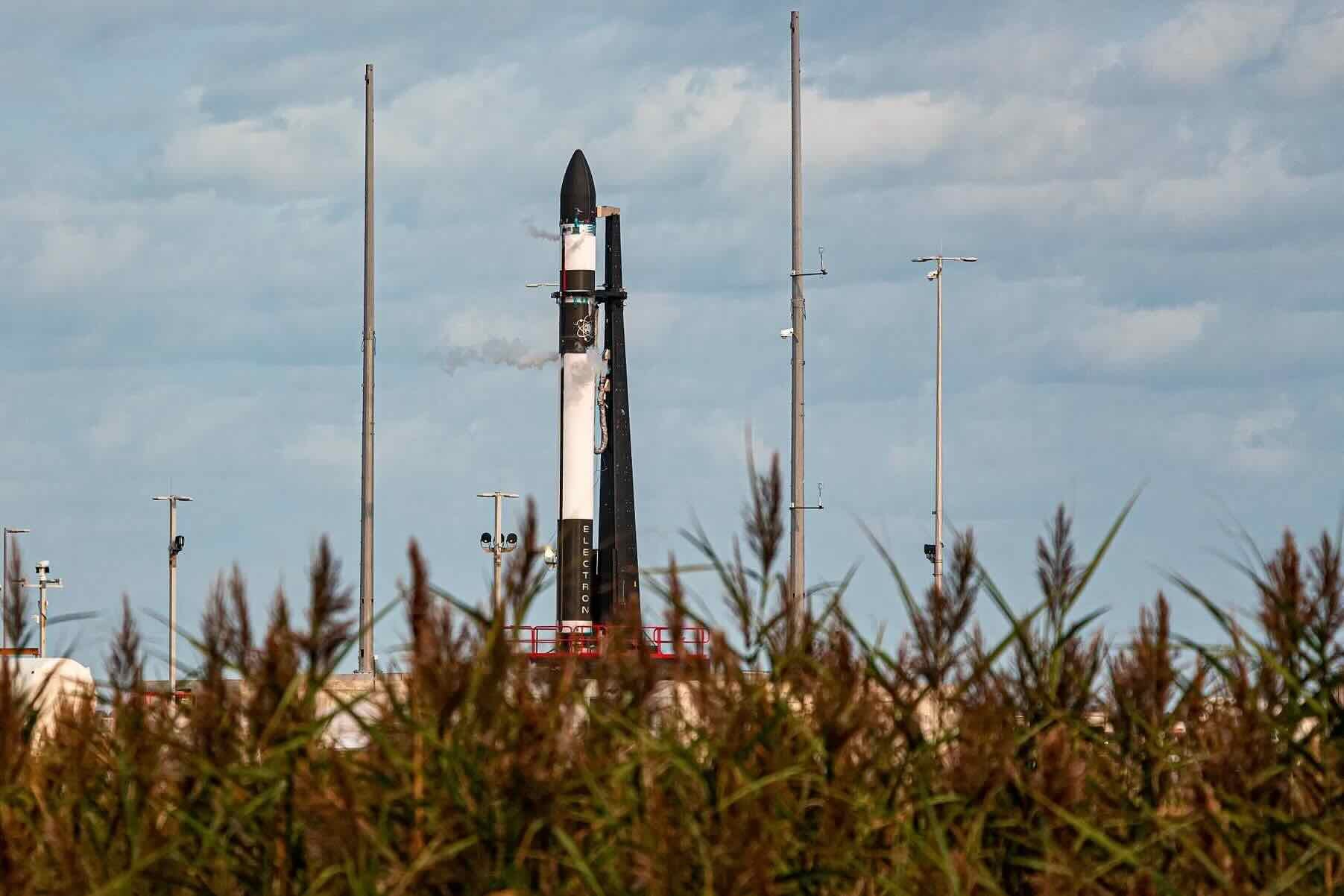
Electron is a two-stage, partially reusable small launch vehicle capable of placing approximately 320 kg into a 500 km sun-synchronous orbit. It debuted in 2017 and has since become the workhorse of the dedicated small-satellite launch market.
In 2025, Rocket Lab flew 21 Electron and HASTE missions with a 100% mission success rate for the year, setting a new annual launch record for the vehicle.
Production guidance from CFO Adam Spice points to roughly 25-plus launches in 2026, anchored by direction to the production team to “produce significantly more rockets in 2026 than in 2025.”
Electron Vehicle Snapshot
- Stages: 2 (carbon-composite structure)
- Engines: 9x Rutherford (1st stage) + 1x vacuum-Rutherford (2nd)
- Propellant: RP-1 / LOX, electric pump-fed
- Payload to LEO: ~320 kg (500 km SSO)
- Launch sites: Mahia (LC-1) & Wallops (LC-2)
- 2025 launches: 21 (incl. HASTE) at 100% success
A key competitive differentiator is dedicated launch.
While SpaceX’s Transporter rideshare missions are cheaper per kilogram, they offer fixed orbital drop-off points; Electron customers select their orbit, schedule, and integration timeline.
This is the value proposition that has won repeat business from operators including BlackSky, iQPS, Synspective, Capella, and HawkEye 360.
HASTE: A Defense-Class Variant That Is Now a Standalone Business
HASTE, the Hypersonic Accelerator Suborbital Test Electron, is a suborbital variant of Electron purpose-built for U.S. and allied hypersonic flight test programs.
In 2025, the Department of Defense awarded Rocket Lab a $190 million contract for 20 HASTE launches in support of hypersonic testing, the company’s largest single launch contract to date.
A successful HASTE flight in February 2026 from Wallops, named “That’s Not A Knife,” carried the DART AE scramjet aircraft for the Defense Innovation Unit, demonstrating that hypersonic test demand has moved from prototype to operational tempo for the company.
This matters because hypersonic testing is widely viewed as one of the highest-priority growth lanes in U.S. defense procurement. Rocket Lab is now embedded as a primary commercial vendor.
Neutron: The Medium-Lift Reusable Rocket That Will Define the Next Decade
Neutron is the program that will most directly determine Rocket Lab’s long-term equity value. It is a partially reusable, medium-lift, two-stage launch vehicle powered by nine Archimedes methalox engines on the first stage and one vacuum Archimedes on the second.
The vehicle is sized to deliver approximately 13,000 kg to low Earth orbit in expendable mode and roughly 8,000 kg in reusable configuration, with first-stage recovery via barge or return-to-launch-site landing.
Neutron Headline Specs
- Configuration: Two-stage, partial reusable
- 1st-stage engines: 9x Archimedes (methane/LOX)
- 2nd-stage engine: 1x vacuum Archimedes
- Payload (expendable): ~13,000 kg to LEO
- Payload (reusable):   ~8,000 kg to LEO
- Fairing: "Hungry Hippo" attached, reusable
- Launch site: Wallops, Virginia (LC-3)
- First flight: Targeting Q4 2026
In late January 2026 a first-stage propellant tank ruptured during a hydrostatic pressure test in Maryland, traced to a hand-laid composite manufacturing defect at a contractor.
CEO Peter Beck publicly acknowledged the setback and pushed inaugural launch to no earlier than the fourth quarter of 2026.
The fix is structural: future tanks will be built with an automated fiber placement machine, eliminating the human-induced defect mode and improving production throughput.
Beck framed the slip as a deliberate trade in favor of vehicle reliability, telling investors the priority is to bring “a reliable rocket to market, even if it means taking a few extra months.”
Archimedes Engine and the Stennis Test Campaign
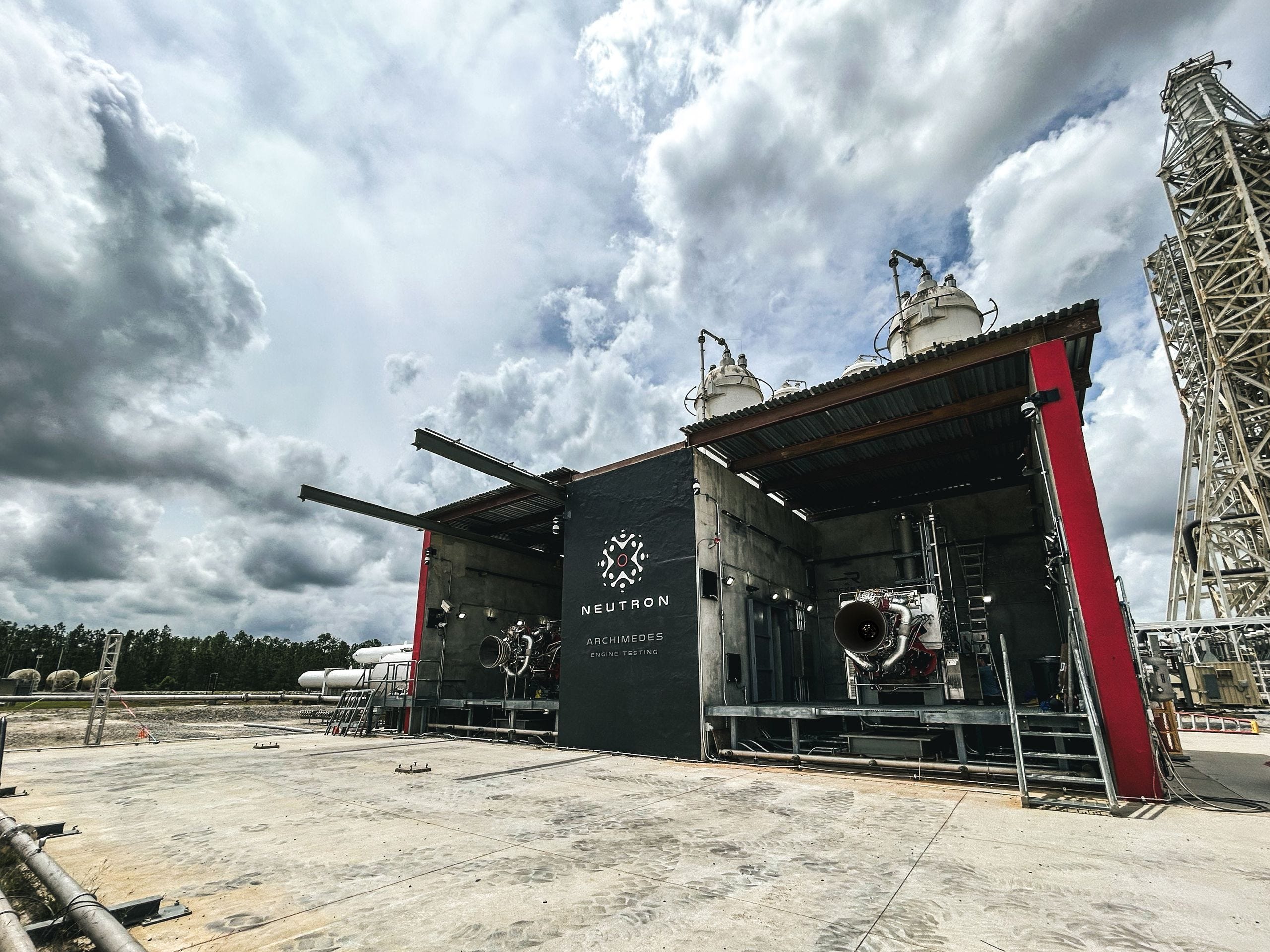
Archimedes is Rocket Lab’s clean-sheet, oxidizer-rich staged-combustion methalox engine. It is rated at 165,000 lbf and is being qualified at NASA’s Stennis Space Center in Mississippi.
Engine testing has been intensive and, at times, dramatic. Public reporting confirms multiple test article failures during 2025 and early 2026, which Beck framed as expected for a development engine campaign.
The engineering reality is that staged-combustion engines are notoriously difficult: SpaceX, Blue Origin, and ULA all suffered repeated test failures during their respective Raptor, BE-4, and BE-3 development cycles.
Investors and customers have so far interpreted Rocket Lab’s public test cadence as a healthy sign that the company is iterating quickly rather than hiding issues.
The Hungry Hippo fairing has already cleared its qualification campaign and was confirmed at the Q4 2025 earnings call as a major program de-risking event. The thrust structure has also reached qualification.
Photon and the Lightning Bus: Spacecraft With Real Heritage
Photon is Rocket Lab’s in-house satellite bus derived from the Electron kick stage and used for both Earth-orbit and deep-space missions.
Photon flew CAPSTONE for NASA to lunar orbit in 2022, and the LOXSAT cryogenic fuel demonstration spacecraft was completed in October 2025 for Eta Space and NASA.
The November 2025 ESCAPADE mission for NASA and UC Berkeley sent twin Rocket Lab-built spacecraft toward Mars aboard a Blue Origin New Glenn rocket, marking the first interplanetary delivery of a Rocket Lab-manufactured bus other than CAPSTONE.
The Lightning satellite platform, in turn, is the bus selected for both SDA Tranche awards. It is designed for high-volume manufacturing and is being scaled in Long Beach to support the more than 36 SDA satellites the company is contracted to deliver across Tranche 2 and Tranche 3.
Flatellite: The Stackable Bus Built for Constellation Economics
In February 2025, Rocket Lab unveiled Flatellite, a stackable, high-power, scalable spacecraft optimized for mass production and large-volume launch on Neutron.
Flatellite is the company’s response to the constellation economics that Starlink and Project Kuiper have driven. The satellite is engineered for vertical stacking and dispenser deployment, and Beck has hinted it will also support Rocket Lab’s own future constellation ambitions.
Flatellite Design Goals (per company disclosures)
- High-volume production line in Long Beach
- Long mission life (multi-year)
- High onboard power for AI and remote sensing
- Stackable form factor for Neutron payload bay
- Designed for both Earth-observation and comms
The strategic implication is that Rocket Lab is positioning itself to vertically integrate from launch to spacecraft to payload to optical comms terminal, an end-to-end stack that very few private space companies can match.
Mars Telecommunications Orbiter Bid
Rocket Lab won a $390,936 NASA study contract and is competing for the $700 million prime contract to build NASA’s Mars Telecommunications Orbiter, with the agency required to award by the end of fiscal 2026 and target a 2028 Mars window.
This is a meaningful proof point for the company’s deep-space ambitions. CAPSTONE proved Photon can transit cislunar space; ESCAPADE proves the bus can be delivered to Mars; MTO would prove Rocket Lab can prime an interplanetary mission.
Geost Payloads and Mynaric Optical Comms
The August 2025 close of the Geost acquisition for $275 million brought in-house an established maker of electro-optical and infrared sensor payloads for U.S. national security missions, including the Phoenix infrared sensor and StarLite space-protection sensor that anchor the Tranche 3 design.
The April 2026 close of Mynaric for $155.3 million added laser optical communications terminals, a subsystem widely identified as a bottleneck in proliferated LEO architectures including the SDA Transport Layer and various commercial constellations.
Vertical Integration Stack After 2026 Acquisitions
1. Launch:        Electron / HASTE / Neutron
2. Bus:           Photon / Lightning / Flatellite / Explorer
3. Subsystems:    Reaction wheels, star trackers, propulsion,
                  solar arrays, separation, software
4. Payloads:      Phoenix IR + StarLite (Geost)
5. Optical Comms: Mynaric CONDOR Mk3 / HAWK terminals
6. Ground Ops:    In-house mission control & ground systems
Few peers, public or private, can claim ownership of all six layers. That breadth is at the heart of Beck’s investor pitch that Rocket Lab is becoming “the new prime.”
Financial Analysis: Rocket Lab
Income Statement: A 38% Growth Year With Improving Margins
Fiscal 2025 marked the largest absolute revenue gain in company history. Total revenue was $601.8 million, up from $436.2 million in 2024 and $244.6 million in 2023.
Q4 2025 alone delivered $179.7 million in revenue, a 36% year-on-year increase and a 16% sequential gain, with GAAP gross margin reaching 38% and Non-GAAP gross margin at 44.3%.
Annual Revenue Trajectory
2022:  $211 million
2023:  $245 million
2024:  $436 million  (+78% YoY)
2025:  $602 million  (+38% YoY)
Q3 2025 had already set a record at $155 million in revenue, up 48% year on year, with GAAP gross margin of 37%, evidencing that margin expansion is structural rather than seasonal.
Net loss for the full year stood at $198.2 million. The loss reflects continued investment in Neutron, Archimedes, the Wallops production complex, integration costs from Geost, and personnel growth, but the company’s operating leverage is now visible.
Segment Breakdown: Space Systems Continues to Dominate the Mix
Although the company’s filings present the consolidated split as “Product revenues” and “Service revenues,” management commentary consistently identifies Space Systems as the larger of the two operating segments.
Space Systems revenue grew 15.3% year on year in Q4 2025 and accounted for the majority of full-year revenue. Launch revenue grew faster on a percentage basis as Electron cadence rose, but Space Systems remains the larger absolute contributor.
FY2025 Revenue Mix (Approximate, per management commentary)
Space Systems:     ~60-65% of revenue
Launch Services:   ~35-40% of revenue
2025 Launches:      21 (Electron + HASTE)
2026 Launch Guide:  ~25+ Electron + 1 Neutron debut
This mix is strategically important because spacecraft and subsystems carry recurring program revenue tied to multi-year contracts, while launch revenue is more transactional, although it is also becoming more programmatic as multi-launch contracts grow.
Q1 2026 Guidance and Forward View
Management guided Q1 2026 revenue between $185 million and $200 million, implying continued sequential growth and a starting point that, if sustained, would put 2026 above $800 million on a run-rate basis.
Spice’s commentary that production capacity should support roughly 20% growth in launch volume implies Electron alone could meaningfully expand the launch contribution before Neutron generates first-flight revenue.
Balance Sheet, Liquidity, and Capital Structure
Rocket Lab ended 2025 with cash and cash equivalents of $828.7 million and total cash on hand (cash plus equivalents and securities) of $1.017 billion.
The capital structure includes the previously issued $355 million convertible senior notes from February 2024 (upsized from $275 million) and the 4.25% convertible notes due 2029 used in part to finance Neutron infrastructure.
Capital allocation has prioritized two themes. First, Neutron and Archimedes remain the largest internal capex line, including Wallops production, the Stennis engine test stand, and tooling for automated composite layup.
Second, M&A has consumed roughly $430 million in headline value across Geost and Mynaric in less than a year, signaling that management views inorganic vertical integration as a faster path than organic build-out for sensor payloads and laser comms.
Backlog: $1.85 Billion Provides 2026 Visibility
The most important non-revenue financial metric is backlog. Rocket Lab ended 2025 at a record $1.85 billion in backlog, up 73% year over year, driven by:
The $816 million SDA Tranche 3 award
The $190 million HASTE multi-launch contract
More than 30 new Electron launch contracts signed in 2025
The Q1 2026 announcement of the Mynaric close added additional revenue streams from the company’s CONDOR Mk3 and HAWK terminal lines, which were already under contract for SDA Tranche 2 buildouts.
Backlog Trajectory
End-2024:   ~$1.07 billion
End-2025:    $1.85 billion  (+73% YoY)
Composition: Launch (Electron, HASTE, Neutron),
             Space Systems (SDA, commercial, NASA),
Subsystems (reaction wheels, solar, OCT)Revenue and Growth Drivers: Rocket Lab
Driver 1: SDA Tranche 2 and Tranche 3 Execution
The two SDA prime contracts together total more than $1.3 billion in awarded value. The Tranche 2 Transport Layer-Beta program covers 18 communications satellites and is in production now.
The Tranche 3 Tracking Layer adds 18 missile-warning and missile-tracking satellites with the Phoenix and StarLite payloads. The company also disclosed that beyond the $816 million prime value, additional subsystem opportunities to other Tranche 3 primes could push total program capture toward roughly $1 billion.
This is the largest single growth lane in the model. Production cadence ramps will translate directly into Space Systems revenue through 2027 and 2028.
Driver 2: Neutron Commercialization
Once Neutron flies, the addressable market expands by an order of magnitude. Medium-lift launch is the largest revenue pool in the global commercial launch market today, dominated by SpaceX’s Falcon 9 and increasingly contested by Blue Origin’s New Glenn.
Rocket Lab has stated publicly that Neutron is being designed for constellation deployment, national security launches, and exploration missions, the same three demand pools that have driven Falcon 9 to a record cadence of more than 130 missions in a single year.
The U.S. government has already issued Neutron a launch approval window valid through January 2027, reinforcing the Q4 2026 inaugural target.
Driver 3: HASTE and Hypersonic Testing
The $190 million 20-launch HASTE contract is the largest commercial hypersonic test launch agreement publicly announced to date.
HASTE Demand Drivers
- DoD priorities: Hypersonic offense + defense
- DIU and Department of War programs
- Allied nations (Five Eyes + select partners)
- Ongoing testing for AGM-183, HACM, LRHW, others
- Scramjet & boost-glide vehicle test campaigns
Because the U.S. is structurally underinvested in hypersonic flight test infrastructure, Rocket Lab benefits from a multi-year wave of repeat contracting that is largely insulated from commercial launch market cyclicality.
Driver 4: Golden Dome Missile Defense Architecture
In April 2026 the U.S. Space Force selected 12 firms for up to $3.2 billion in Golden Dome missile-defense interceptor concept work, of which Rocket Lab is one. The total Golden Dome program is sized in the $175 billion range over its full lifecycle.
Rocket Lab is positioned through both the Geost payload heritage and the Lightning bus to bid on tracking, custody, and interceptor-cueing work as Golden Dome contracts are released.
Driver 5: Mars Telecommunications Orbiter
If awarded, the Mars Telecommunications Orbiter contract would be a $700 million prime contract anchored on a 2028 Mars launch window, providing a multi-year program revenue stream into the late 2020s.
Driver 6: Photon and Mynaric Cross-Sell
With Mynaric integrated, Rocket Lab can now sell entire Photon or Lightning satellites with optical inter-satellite links pre-installed, an offering that is meaningful because every major proliferated LEO architecture, defense or commercial, requires laser comms.
Revenue LTM and Run-Rate
Last-twelve-months revenue through Q4 2025 was $601.8 million. On the midpoint of Q1 2026 guidance ($192.5 million), the implied Q1 run-rate is approximately $770 million, and continued sequential acceleration plus Neutron’s potential contribution late in the year sets up 2026 to be the second consecutive year of >35% growth.
Major Competitors
List of Major Competitors
The competitive set spans launch, spacecraft, and defense systems. Direct and adjacent competitors include:
SpaceX (launch, constellations, Starshield)
Blue Origin (medium-lift via New Glenn, lunar systems)
United Launch Alliance (Vulcan Centaur)
Firefly Aerospace (small to medium lift, lunar lander)
Northrop Grumman (Antares, satellites, defense primes)
Lockheed Martin (defense primes, Tranche 3)
L3Harris Technologies (Tranche 3, sensors)
Sierra Space (Dream Chaser, defense space systems)
Relativity Space (Terran R medium-lift in development)
Stoke Space (Nova, fully reusable medium lift)
Maxar Intelligence and York Space (spacecraft buses)
Rocket Lab vs. SpaceX
The simplest framing is that Rocket Lab is not trying to beat SpaceX in raw launch cadence; it is competing on dedicated launch, spacecraft prime work, and vertically integrated subsystems where SpaceX rarely sells outside its own constellations.

Rocket Lab (RKLB) vs. SpaceX
                       Rocket Lab          SpaceX
Annual launches '25:   21 Electron+HASTE   ~130+ Falcon
Medium-lift status:    Neutron in dev      Falcon 9 mature
Heavy-lift status:     None planned        Starship in dev
Constellation:         Optional/Flatellite Starlink (~9k sats)
Spacecraft for sale:   Yes (extensively)   Limited
Subsystems for sale:   Yes (broad catalog) Largely captive
Defense prime status:  Yes (SDA T2 + T3)   Starshield only
Public market:         Listed (Nasdaq)     Private
SpaceX dominates raw launch market share and Starlink continues to scale. However, Rocket Lab has grown faster on a percentage basis recently and has a fundamentally different business model: it sells “picks and shovels” to the broader space industry, as Beck himself describes it.
The most direct head-to-head will come once Neutron is operational. Even then, Rocket Lab is targeting medium-lift demand, not Falcon Heavy or Starship class missions.
Rocket Lab vs. Firefly Aerospace
Firefly went public in 2025 and is now Rocket Lab’s most directly comparable U.S.-listed peer. Firefly operates the Alpha small launcher, the Blue Ghost lunar lander, and is co-developing Eclipse (medium-lift) with Northrop Grumman.
Rocket Lab (RKLB) vs. Firefly (FLY)
                          Rocket Lab     Firefly
2025 Revenue:             $602M          ~$160M
Annual launches '25:      21             1 Alpha (orbital)
Medium-lift program:      Neutron        Eclipse (w/ NG)
Lunar lander:             Photon-class   Blue Ghost (active)
Defense prime contracts:  $1.3B+ SDA     Smaller scale
Backlog:                  $1.85B         Disclosed smaller
Vertical integration:     Very high      Moderate
Firefly recorded a larger net loss in 2025 despite materially smaller revenue, and Alpha has had multiple anomaly events. Rocket Lab’s much larger Space Systems business and far higher launch cadence make it the more mature operator across both segments.
Rocket Lab vs. Northrop Grumman and Lockheed Martin
The legacy primes are the contractors Rocket Lab is most explicitly trying to disrupt in defense.
In Tranche 3, Rocket Lab won $805 million, Lockheed Martin won $1.1 billion, and Northrop Grumman won $764 million, placing Rocket Lab squarely between them as a peer prime.

Tranche 3 Tracking Layer Award Comparison
- Lockheed Martin:    $1.10 billion (24 SVs)
- Rocket Lab:         $0.805 billion (18 SVs)
- Northrop Grumman:   $0.764 billion (18 SVs + 12 SVs with L3H)
- L3Harris:           $0.64 billion (12 SVs + Northrop SV scope)
The differentiator is unit economics.
Rocket Lab manufactures the bus, the propulsion, the solar arrays, the avionics, the payload, and the optical comms terminal in-house.
The legacy primes must aggregate these from external suppliers, which slows production and adds margin layers.
Rocket Lab vs. ULA, Blue Origin, Stoke, Relativity (Medium-Lift Lane)
The most relevant medium-lift competitors for Neutron’s commercial market are Falcon 9, New Glenn (Blue Origin), Vulcan (ULA), Terran R (Relativity), and Nova (Stoke).
Of these, only Falcon 9 has operational reusability today. New Glenn flew its first mission and recovered its booster on Mission 2; Vulcan is operational but expendable; Neutron, Terran R, and Nova are all targeting first launch within 2026-2027.
Neutron’s wedge is partial reusability with high payload to LEO and a price point designed to compete with Falcon 9 in dedicated medium-lift missions, particularly for U.S. national security launch certifications.