
As the electric vertical takeoff and landing (eVTOL) sector continues its maturation, Wisk Aero has emerged as one with its singular focus on fully autonomous passenger flight.
The Boeing-backed company recently completed assembly of its Generation 6 prototype, marking a significant milestone in the company’s trajectory toward commercial service deployment by 2030.
Table of Contents
Also Read:


Strategic Positioning in the eVTOL Sector
Wisk stands apart from competitors through its unwavering commitment to autonomous operations. While many eVTOL manufacturers pursue pilot-assisted models, the Mountain View-based company represents the only developer dedicated exclusively to pilotless passenger aircraft in the advanced air mobility (AAM) space.
This strategic differentiation stems from the company’s origins as Kitty Hawk, founded with backing from Google co-founder Larry Page, before Boeing’s $450 million investment in January 2022 established it as one of the most capitalized entities in the sector.
WISK AERO CORPORATE STRUCTURE
================================
Parent Company: The Boeing Company (100% ownership)
Headquarters: Mountain View, California
Operational Facilities: Hollister, CA (flight testing)
Subsidiaries: SkyGrid (acquired June 2025)
The Boeing relationship extends beyond financial support. The aerospace giant provides Wisk with access to certification expertise, manufacturing knowledge, and regulatory relationships that few startups could replicate independently.
This partnership positions Wisk to navigate the complex Federal Aviation Administration (FAA) certification pathways required for autonomous passenger operations.
Leadership Transformation and Technical Direction
In May 2025, Wisk appointed Sébastien Vigneron as CEO, succeeding Brian Yutko who transitioned to Boeing leadership.
Vigneron brings extensive aerospace development experience from Bombardier and Dassault Aviation, including oversight of aerodynamics programs for business jet platforms. His technical background aligns with the company’s current phase focused on prototype testing and certification preparation.
Under Vigneron’s leadership, Wisk has accelerated prototype development while maintaining the company’s methodical approach to safety validation. The CEO’s engineering pedigree reflects Boeing’s preference for technical leadership during the critical aircraft certification phase.
Generation 6 Aircraft: Technical Specifications and Capabilities

Image Credit: Wisk Aero
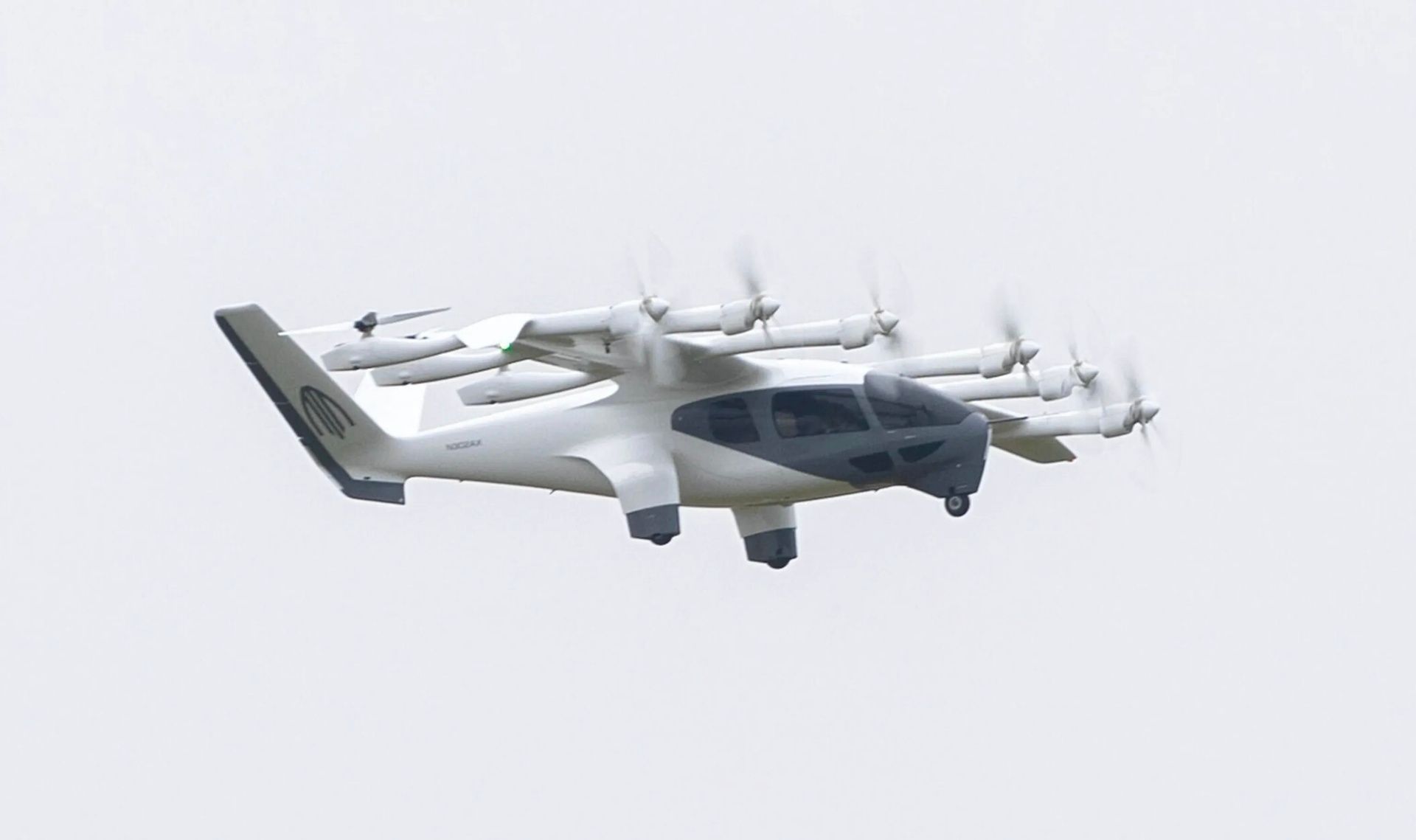
The Generation 6 prototype represents Wisk’s sixth iteration of autonomous eVTOL design. The four-seat, all-electric aircraft employs a distinctive 12-propeller configuration with tilting mechanisms that enable both vertical takeoff and forward flight.
This architecture differs from competitors’ designs through its emphasis on redundancy and simplified mechanical systems.
Specification | Performance |
|---|---|
Cruise Speed | 110-120 knots (138 mph / 222 km/h) |
Range | 90 miles with reserves (144 km) |
Operational Altitude | 2,500-4,000 feet |
Passenger Capacity | 4 seats |
Recharge Time | ~15 minutes |
Propulsion | 12 electric motors with tilt capability |
The aircraft’s design philosophy prioritizes safety through redundancy. According to Wisk’s technical documentation, every flight-critical system features backup capabilities, from battery architecture to propulsion systems. The company has deliberately minimized moving parts to reduce potential failure points, a contrast to more mechanically complex competitor designs.
The Gen 6’s autonomous flight system represents a fusion of Wisk’s proprietary technology and capabilities gained through the June 2025 acquisition of SkyGrid. SkyGrid’s airspace integration platform enables autonomous aircraft to operate alongside conventional traffic, providing detect-and-avoid capabilities and communications with air traffic management systems.
Flight Testing Progression and Certification Timeline
On December 8, 2025, Wisk transferred its first Gen 6 prototype from the assembly team to flight operations at its Hollister, California test facility. The bright-yellow aircraft will conduct restrained ground testing before progressing to untethered flight operations.
The test program focuses on validating hover characteristics, low-speed stability, and transition flight profiles.
FLIGHT TEST PROGRAM PHASES
===========================
Phase 1: Restrained ground tests (Current)
Phase 2: Hover profile validation
Phase 3: Transition flight testing
Phase 4: Forward flight envelope expansion
Phase 5: Autonomous systems validation
Timeline: Initial flight expected Q4 2025/Q1 2026
Wisk has submitted its G-1 and G-2 certification basis documents to the FAA, establishing the regulatory framework for type certification.
While the company has not disclosed a specific certification completion date, industry reports project a late 2020s timeline for type certification approval, with commercial operations potentially beginning around 2030.
The autonomous certification pathway presents unique challenges absent from piloted aircraft programs. Wisk must demonstrate equivalent or superior safety to conventional aviation through software validation, hardware redundancy testing, and failure mode analysis.
The company has conducted nearly 2,000 test flights across earlier prototype generations, accumulating operational data that informs certification efforts.

Image Credit: Wisk Aero
Market Strategy and Launch Cities
Wisk has identified four initial deployment markets for commercial service: Houston, Los Angeles, Miami, and Brisbane, Australia.
The selection criteria emphasized metropolitan areas with significant traffic congestion, supportive regulatory environments, and existing aviation infrastructure adaptable to vertiport operations.
Target Market Analysis
City | Key Attributes | Infrastructure Status |
|---|---|---|
Houston | Strong aerospace industry presence, Ellington Airport proximity | MOU with Signature Aviation |
Los Angeles | Large addressable market, traffic congestion | Planning vertiport locations |
Miami | Tourism demand, waterfront operations potential | Partnership with Miami-Dade County |
Brisbane | International market testing, regulatory cooperation | Government collaboration agreements |
In August 2025, Wisk formalized a partnership with Signature Aviation, the world’s largest fixed-base operator network.
This collaboration focuses on adapting existing private aviation terminals for autonomous eVTOL operations, including vertiport concept development, operational workflow definition, and charging infrastructure integration. Signature operates facilities in all three U.S. target cities, providing Wisk with immediate access to aviation-grade real estate.
The company’s economic model targets $3 per passenger per mile, positioning autonomous air taxi service as accessible transportation rather than luxury transport. This pricing structure reflects cost advantages from eliminating pilot expenses, though achieving this target depends on achieving high aircraft utilization rates and operational efficiency.
Technological Differentiation: The Autonomy Advantage
Wisk’s autonomous architecture addresses one of aviation’s most persistent challenges: human factors in safety incidents. By eliminating pilot error, the company aims to achieve safety levels exceeding conventional aviation’s record.
However, this approach demands extraordinary software reliability and fail-safe hardware design.
The autonomous system employs multiple redundant sensors, including LIDAR, radar, and optical cameras, to build comprehensive environmental awareness. Machine learning algorithms process sensor data to execute flight decisions, while rule-based systems provide deterministic safety boundaries.
A remote operations center maintains oversight of all flights, with human operators capable of intervening during anomalous conditions.
AUTONOMOUS SYSTEM ARCHITECTURE
================================
Sensor Suite:
- Multi-spectrum cameras
- LIDAR arrays
- Radar systems
- GPS/GNSS positioning
- Inertial measurement units

Processing Layers:
- Perception (environmental understanding)
- Planning (route and maneuver optimization)
- Control (flight surface and power management)
- Monitoring (anomaly detection)

Human Oversight:
- Remote operations center
- Multi-aircraft supervision
- Intervention protocols
The SkyGrid integration strengthens Wisk’s technological position by providing proven airspace management capabilities. SkyGrid’s platform already supports unmanned aircraft operations for defense and commercial customers, offering flight planning, traffic deconfliction, and regulatory compliance tools that transfer directly to passenger eVTOL operations.
Competitive Analysis and Industry Position
The eVTOL sector features numerous competitors pursuing varied technical approaches.
Joby Aviation and Archer Aviation lead in piloted eVTOL development, with both companies further advanced in FAA certification than Wisk. Volocopter and Lilium pursue European certification pathways, while Chinese manufacturers like EHang emphasize cargo and emergency service applications.
Wisk’s autonomous-only strategy creates both advantages and challenges relative to competitors. The approach eliminates pilot training costs and enables higher aircraft utilization through continuous operations.
However, autonomous certification requirements add complexity and timeline risk compared to piloted aircraft pathways. The company accepts these tradeoffs based on its assessment that autonomous operations represent the only path to truly scalable urban air mobility.
From a financial perspective, Boeing’s backing provides Wisk with funding stability that many competitors lack. Several eVTOL manufacturers face capital constraints as development timelines extend beyond initial projections. Wisk’s position as a wholly-owned Boeing subsidiary insulates it from near-term profitability pressures while the company focuses on certification completion.
Infrastructure Development and Operational Readiness
Beyond aircraft development, Wisk is actively building the operational infrastructure required for commercial service. The Signature Aviation partnership addresses ground operations, while the SkyGrid acquisition provides digital infrastructure for fleet management and air traffic integration.
October 2025 saw Wisk select Liebherr-Aerospace as the supplier for Gen 6’s electro-mechanical actuation system, which controls flight surfaces. This partnership brings aerospace-grade component reliability to the eVTOL platform, addressing certification authorities’ expectations for component heritage and supplier qualification.
Wisk has also secured partnerships with local governments in target markets. The City of Fullerton, California collaboration and Miami-Dade County agreement provide public sector endorsement and facilitate regulatory discussions at the municipal level.
Outlook for 2026 and Beyond
The year 2026 represents a pivotal period for Wisk’s progression. The company must successfully complete Gen 6 flight testing, demonstrate autonomous system reliability across diverse operating conditions, and advance FAA certification milestones. A second Gen 6 prototype currently under assembly will expand testing capacity and provide validation aircraft for certification authorities.
Key performance indicators for 2026 include:
Flight test hours accumulated: Demonstrating system maturity through extensive testing
Certification basis acceptance: FAA approval of proposed means of compliance
Supplier qualification completion: Finalizing component suppliers for production aircraft
Infrastructure site selection: Confirming vertiport locations in launch cities
The timeline toward 2030 commercial operations remains ambitious. No autonomous passenger eVTOL has achieved type certification in any jurisdiction, establishing Wisk as a regulatory trailblazer. Success requires not only technical achievement but also regulatory framework development for this novel aircraft category.
Wisk’s approach reflects a long-term perspective enabled by Boeing’s backing. Rather than pursuing accelerated timelines that risk safety or certification delays, the company emphasizes methodical testing and comprehensive validation. This strategy may result in market entry after some piloted competitors, but Wisk maintains that autonomous operations offer superior long-term economics and scalability.
The broader eVTOL sector’s maturation will influence Wisk’s trajectory. Regulatory precedents established by earlier certifications will inform autonomous aircraft pathways. Public acceptance of eVTOL operations will determine market size and pricing dynamics. Infrastructure development by municipalities and private operators will enable or constrain operational scope.
My Final Thoughts
Wisk Aero occupies a unique position in advanced air mobility as the sole developer pursuing fully autonomous passenger eVTOL operations from program inception.
The completion of Gen 6 prototype assembly and imminent flight testing marks the company’s transition from development to validation phase. Boeing’s financial and technical support provides resources few competitors can match, while partnerships with Signature Aviation and SkyGrid address operational requirements beyond aircraft performance.
The path to 2030 commercial operations presents substantial technical and regulatory challenges. Autonomous certification requirements demand unprecedented levels of system reliability and safety demonstration.
However, Wisk’s methodical approach, backed by aerospace industry expertise and adequate capitalization, positions the company to potentially achieve this ambitious objective.
For eVTOL professionals, regulatory authorities, and industry stakeholders, Wisk’s progress serves as a barometer for autonomous aircraft certification feasibility. The company’s success or challenges will inform broader discussions about urban air mobility’s technical pathways and operational frameworks.
As the Gen 6 prototype begins flight testing in early 2026, the industry will gain concrete data on autonomous eVTOL capabilities and the timeline to commercial reality.