


Executive Summary
Dassault Aviation closed 2025 with net sales of EUR 7.4 billion, adjusted operating income of EUR 635 million, and adjusted net income of EUR 1,061 million, while sitting on a record EUR 46.6 billion backlog covering 220 Rafale and 73 Falcon aircraft.
Rafale production is in a multi-year ramp from roughly two aircraft per month toward four per month by 2029, supported by extended buildings at Martignas and Argenteuil and a freshly signed production transfer to TASL in Hyderabad.
The civil Falcon line is repositioning around the new long-range Falcon 10X, unveiled in Bordeaux on 10 March 2026, which directly targets the Gulfstream G700/G800 and Bombardier Global 7500/8000 segments.
Future Combat Air System governance is the most material strategic risk: Dassault publicly questions Airbus partnership terms and floats a two-to-three week deadline for resolution, while quietly advancing a sovereign French UCAV and Rafale F5 standard as a Plan B.
Recommended - Read Full Reports


Read All Reports
Table of Contents
Executive Summary
Introduction
Key Facts: Dassault Aviation Company Profile
Dassault Aviation Company Overview
A Family-Controlled Champion of European Aerospace
Two Segments, One Industrial DNA
Industrial Footprint and Sites
Key Product Lines and Programs
The Rafale: Backbone of the Defense Portfolio
Rafale F5 Standard and Loyal Wingman Architecture
Production Ramp and Supply Chain
The Falcon Family: Civil Aviation Crown Jewel
Falcon 6X: A Mature Mid-Cycle Workhorse
Falcon 10X: The Long-Range Flagship
Multi-Role Falcon Platforms
nEUROn and the Path to Sovereign UCAVs
FCAS / SCAF: The Program at a Crossroads
Other Programs: Atlantique 2, Falcon Albatros, and AVSIMAR
Financial Analysis: Dassault Aviation
2025 Headline Results
Backlog Quality and Visibility
Cash Position and Capital Allocation
2026 Guidance and Forward Trajectory
Dassault Aviation Revenue and Growth Drivers
Rafale Export Momentum
India: From Customer to Industrial Partner
Falcon Recovery and the 10X Cycle
Customer Support: A Quietly Compounding Annuity
Last-Twelve-Months Revenue Posture
Major Dassault Aviation Competitors
Defense (Combat Aircraft) Competitors
Civil (Business Aviation) Competitors
Dassault vs. Lockheed Martin
Dassault vs. Eurofighter Consortium
Dassault vs. Boeing Defense
Dassault vs. Gulfstream
Dassault vs. Bombardier
Dassault Aviation Competitive Analysis and Moat
What Dassault’s Moat Actually Is
Where the Moat Has Limits
Strategic Implications and Industry Positioning
Falcon 10X as a Civil Strategy Reset
Defense Strategy in a Multi-Polar Order
India as the Second Industrial Pole
Financial and Commercial Implications
Margin Trajectory
Working Capital and Customer Advances
Implications for the Aerospace Supply Chain
Capital Return and Strategic Optionality
Key Risks with Probabilities and Scenarios
Risk 1: FCAS Program Collapse or Major Restructuring
Risk 2: Rafale Production Ramp Slippage
Risk 3: Indian Industrial Partnership Execution
Risk 4: Falcon 10X Schedule and Certification
Risk 5: Geopolitical and Export-Control Headwinds
Risk 6: Business Aviation Cycle Reversal
Risk 7: Supply Chain Inflation and Raw Materials
Dassault Aviation SWOT Analysis
Strengths
Weaknesses
Opportunities
Threats
Outlook for 2026 and Beyond
The Three Strategic Tests of 2026
Beyond 2026: The 2029-2030 Horizon
Long-Term Thesis Through 2040
My Final Thoughts
Official Sources and Data
Introduction
The French manufacturer, Dassault Aviation, just closed 2025 with a 19% jump in net sales, a record EUR 46.6 billion backlog, and a freshly unveiled Falcon 10X flagship rolling out of Bordeaux.
Yet behind the headline numbers sits a company at the eye of multiple storms: a fractious Future Combat Air System dispute with Airbus, an India industrialization push of unprecedented scale, and a Rafale production ramp that must thread the needle between geopolitical demand and supply chain constraint.
This report unpacks how Dassault is positioned for the rest of the decade across its aviation, aerospace, and defense segments.

Key Facts: Dassault Aviation Company Profile
- Headquarters: Saint-Cloud, Île-de-France, France
- Founded: 1929 (as Société des Avions Marcel Bloch)
- Listing: Euronext Paris (ticker AM)
- Chairman & CEO: Eric Trappier
- 2025 Net Sales: EUR 7.4 billion
- 2025 Adjusted Operating Income: EUR 635 million
- 2025 Adjusted Net Income: EUR 1,061 million
- Backlog (31 Dec 2025): EUR 46.6 billion
- Rafale order book: 533 aircraft (cumulative)
- Falcon family fleet in service: ~2,100 aircraft
- Major shareholder: Groupe Industriel Marcel Dassault
- Strategic stake held: 27% of ThalesThe group consolidates 100% of Dassault Falcon Jet Corp. in the United States and 100% of Dassault Falcon Service in France, alongside a 51% stake in Dassault Reliance Aerospace Limited in India.
Its 27% interest in Thales is one of the most strategically important cross-shareholdings in European aerospace, providing a pipeline into radar, electronic warfare, and avionics technologies that flow directly into Rafale and Falcon programs.

The workforce sits in the low five-digits range across French sites, including Saint-Cloud, Mérignac (Bordeaux), Martignas, Argonay, Argenteuil, Biarritz, Cazaux, Istres, Poitiers, and Seclin, plus US operations in Little Rock and Teterboro.
Dassault recruited around 2,400 employees in 2024 alone, including roughly 240 apprentices, reflecting the production ramp underway.
Dassault Aviation Company Overview
A Family-Controlled Champion of European Aerospace
Dassault Aviation traces its lineage back to 12 December 1928, when Marcel Bloch founded the Société des Avions Marcel Bloch. After World War II, Bloch adopted the surname Dassault, renamed the firm, and rebuilt French combat aviation around a string of iconic Mirage aircraft.
The company today remains controlled by Groupe Industriel Marcel Dassault, and its dual identity is unusual in the industry: a private-feel, family-stewarded business that simultaneously operates as a publicly listed prime contractor for one of Europe’s most strategic defense capabilities.
That family stewardship matters. It allows multi-decade program horizons, conservative capital allocation, and a debt-light balance sheet that few peers can replicate.
Two Segments, One Industrial DNA
Operationally, Dassault straddles two distinct end-markets that share a single industrial spine.
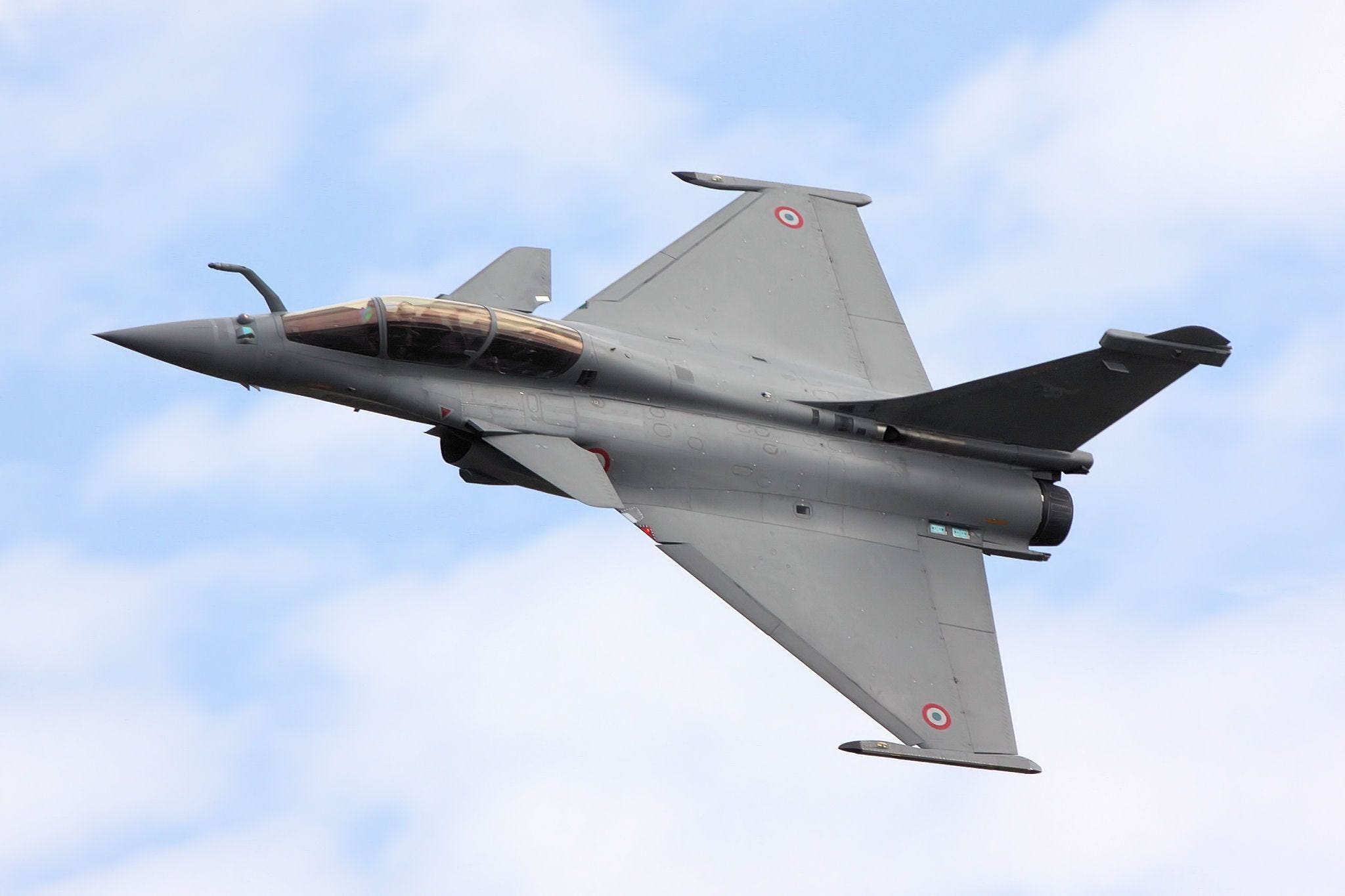
The defense segment designs, builds, and supports the Rafale omnirole fighter, the nEUROn UCAV demonstrator, the Atlantique 2 maritime patrol aircraft, and a growing family of multi-role Falcons configured for surveillance and special missions.
The civil segment designs, builds, and supports the Falcon family of business jets.
2025 SEGMENT MIX
- Defense activities: ~63% of revenue
- Civil activities: ~37% of revenue
- 2024 mix: defense slightly lower; Falcon 6X ramp lifted civil share in 2025
Both segments share the same Mérignac final assembly site for fuselage integration and the same flight-test infrastructure at Istres, which is one reason the company can absorb cyclical swings between defense and business aviation without restructuring.
Industrial Footprint and Sites
Dassault’s industrial map is concentrated in France but with deep US service infrastructure.
The Mérignac plant near Bordeaux is the heart of Rafale and Falcon final assembly. Argonay produces flight controls, Argenteuil manufactures fuselage components, and Martignas builds wings.
Recent capacity investments are visible: the company extended buildings at Martignas in April 2025 to expand Rafale wing production, and Mérignac is being reorganized to accommodate Falcon 10X assembly in parallel with Rafale.
In the United States, Dassault Falcon Jet’s Little Rock completion center finishes interiors and paint for North American customers, and a new state-of-the-art MRO facility opened in Melbourne, Florida to support an expanding installed Falcon fleet.
KEY INDUSTRIAL SITES
- Mérignac (Bordeaux): Final assembly, Rafale & Falcon
- Saint-Cloud: HQ, design office
- Martignas: Wings (Rafale, Falcon)
- Argenteuil: Fuselage sections
- Argonay: Flight controls, hydraulics
- Istres: Flight test center
- Little Rock (Arkansas): Falcon completion center
- Teterboro (NJ): Falcon US headquartersKey Product Lines and Programs
The Rafale: Backbone of the Defense Portfolio
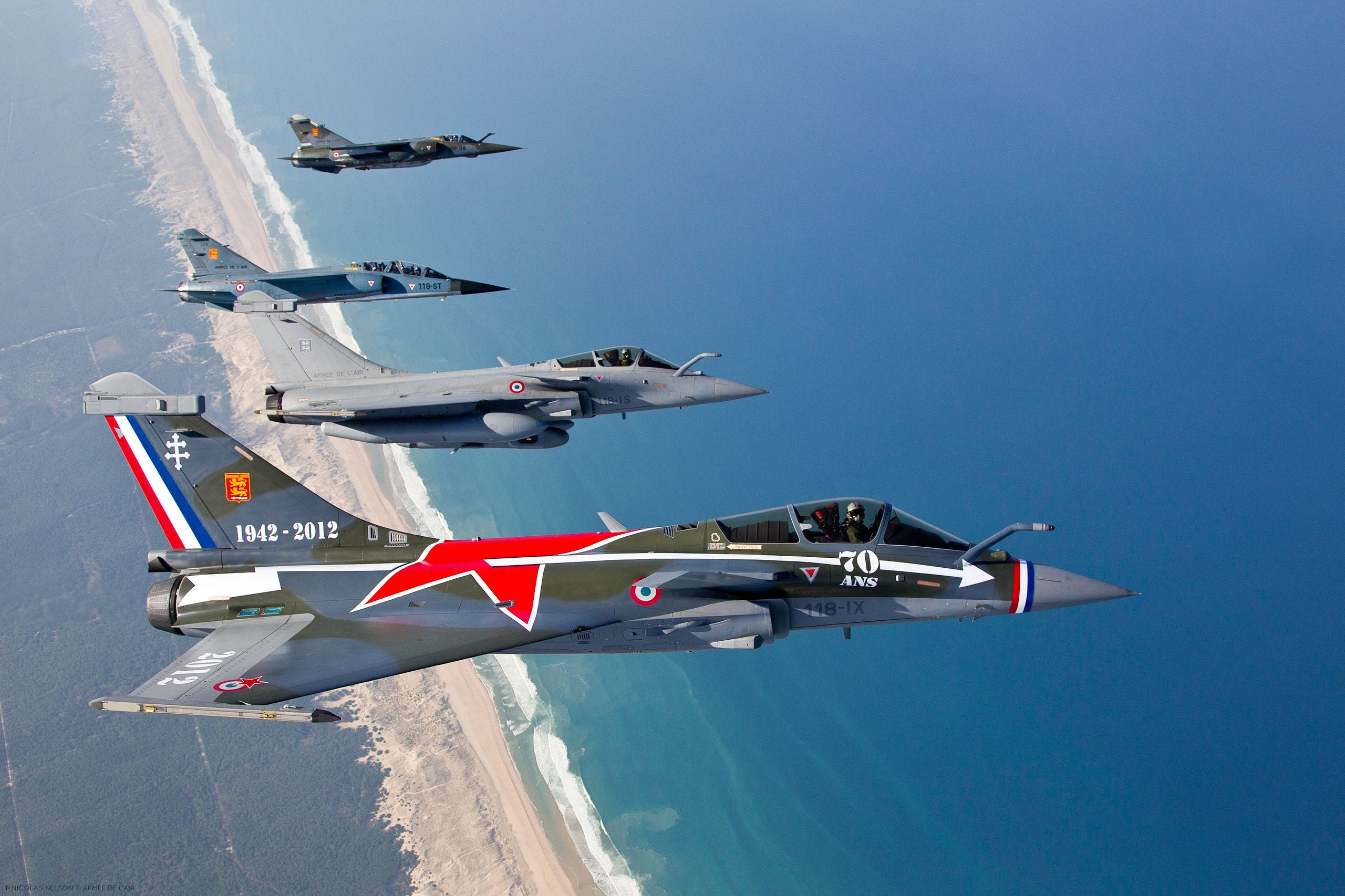
The Rafale is a twin-engine, canard-delta omnirole combat aircraft and the company’s single most important product. It is in service with eight customers including France, Egypt, Qatar, India, Greece, Croatia, Indonesia, the UAE, and most recently Serbia.
By the close of 2025, the cumulative Rafale order book had reached 533 aircraft, with the 300th Rafale rolled out at Mérignac during the year. The current backlog sits at 220 aircraft, comprising 175 export units and 45 for the French armed forces.
Operationally, deployed Rafales fly the F3R standard, while the F4 standard is being progressively delivered with enhanced sensors, connectivity, and weapons integration.
Rafale F5 Standard and Loyal Wingman Architecture
The next iteration, the F5 standard, is the strategically decisive upgrade. France launched F5 development to deliver a substantial leap in connectivity, sensor fusion, and the ability to control loyal wingman drones in collaborative combat formations.
F5 will integrate a new electronic warfare suite, an updated RBE2 radar, the upgraded ASMPA-R nuclear cruise missile, and a fully digital cockpit architecture.
Crucially, it positions the Rafale as a manned node controlling stealthy unmanned combat air vehicles, partially compensating for the absence of a clean-sheet European fifth-generation fighter in the near term.
RAFALE F5 KEY UPGRADES (per French DGA roadmap)
- Enhanced RBE2 radar capability
- Upgraded SPECTRA EW suite
- Loyal wingman / CCA control architecture
- ASMPA-R nuclear standoff missile integration
- New digital cockpit and connectivity stack
- Target initial operational capability: ~2030
Dassault is also integrating combat AI capabilities through a partnership announced with Harmattan AI, plus a strategic partnership with Thales’ cortAIx for sovereign AI applications in air combat.
Production Ramp and Supply Chain
In 2025, Dassault delivered 26 Rafale, of which 11 went to the French armed forces and 15 to export customers. Booked orders of 26 new export units in the year roughly stabilized the Rafale backlog at 220 aircraft.
The production rate climbed from approximately two aircraft per month toward three per month during 2025, with a target of four per month by 2029. Eric Trappier has been transparent that supply chain remains the binding constraint, particularly for landing gear, forgings, and certain high-end electronic components.
For 2026, the company guides 28 Rafale deliveries, which would be the highest annual cadence in the program’s history.
The Falcon Family: Civil Aviation Crown Jewel
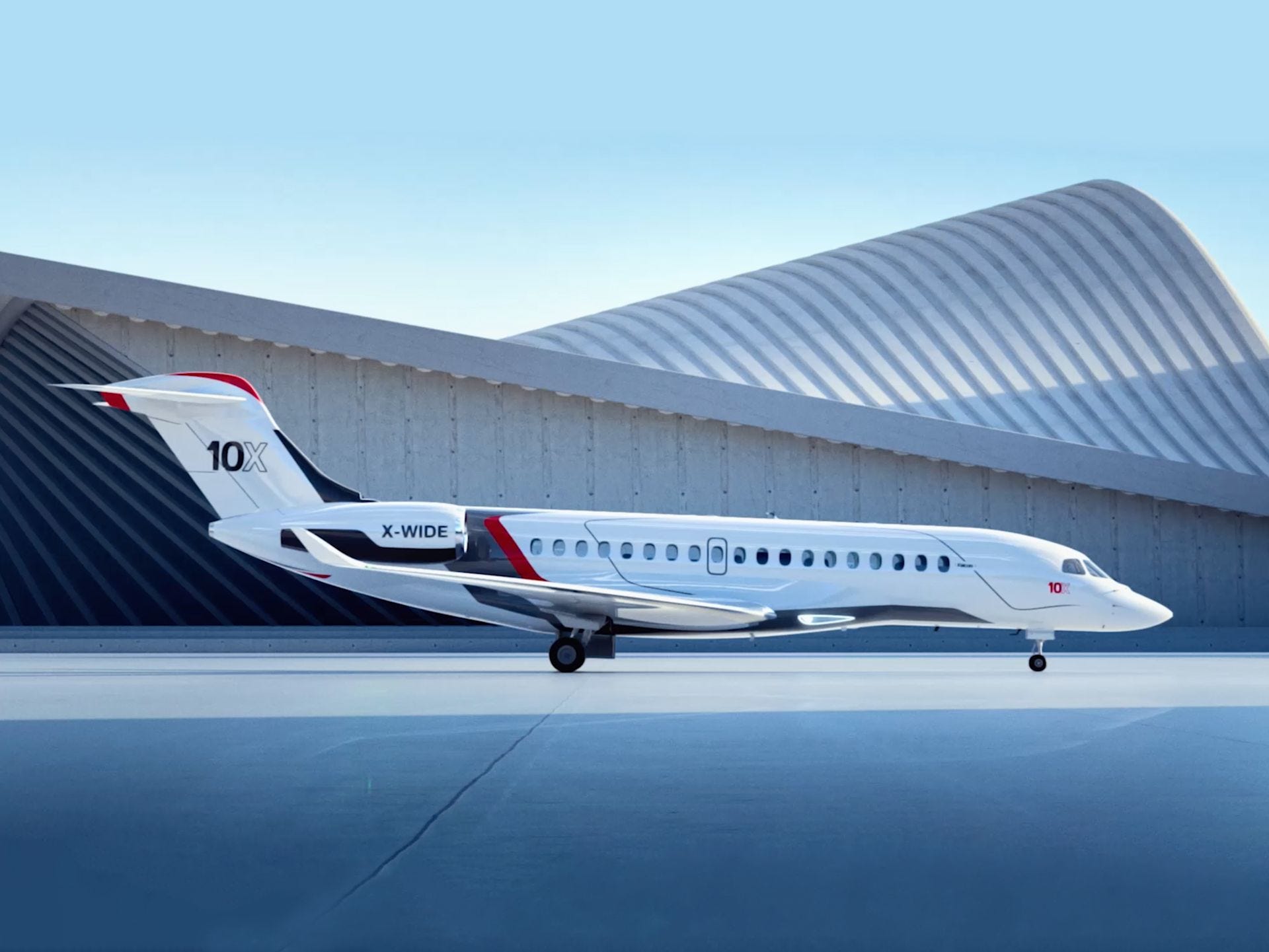
The Falcon line spans the Falcon 2000LXS, Falcon 6X, Falcon 8X, Falcon 900LX, and now the Falcon 10X. More than 700 Falcon 2000s alone have been produced over the program’s lifetime, accumulating over 3.8 million flight hours.
In 2025, Dassault delivered 37 Falcon business jets versus 31 in 2024, with Falcon revenue of EUR 2.77 billion, up 22% year-on-year. New Falcon order intake reached 31 aircraft, with the Falcon backlog ending the year at 73 units valued at part of the EUR 46.6 billion total backlog.
Falcon 6X: A Mature Mid-Cycle Workhorse
The Falcon 6X received concurrent FAA and EASA type certification on 22 August 2023, and the first aircraft entered service shortly after.
By the end of 2025, the type had been in service for roughly two years and the operational fleet had built solid dispatch reliability metrics.
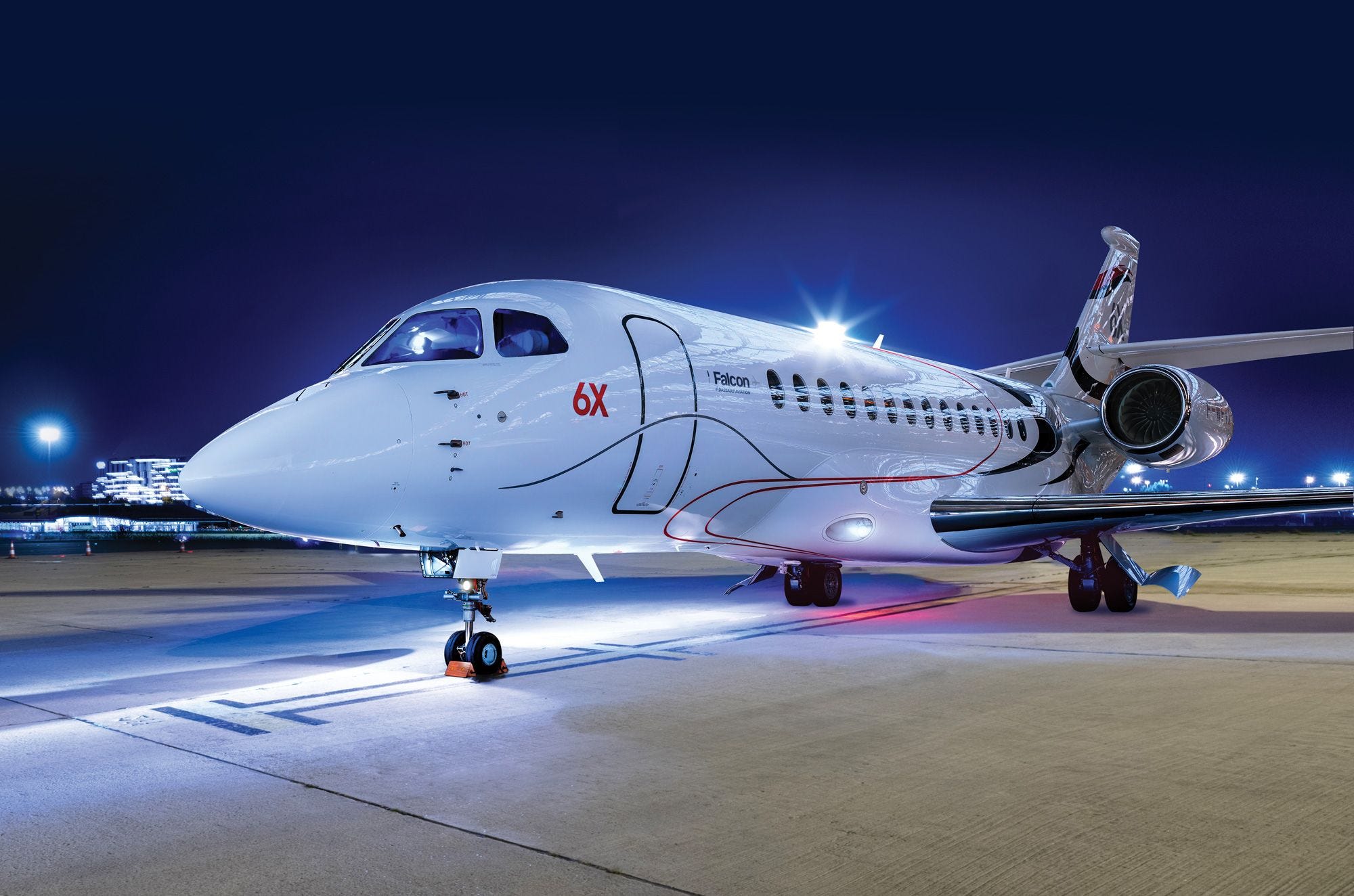
FALCON 6X SPECIFICATIONS
- Range: 5,500 nm at Mach 0.80
- MMO: Mach 0.90
- Engines: 2 x Pratt & Whitney Canada PW812D
- Thrust: ~13,460 lbf each
- Cabin width: 8 ft 6 in (widest in segment until 10X)
- Passengers: typical 12-16, max 19
- Crew: 2-3
Powered by Pratt & Whitney Canada PW812D engines, the 6X targets corporate flight departments and charter operators looking for ultra-quiet ride and the largest cabin in the 5,500 nm segment.
Falcon 10X: The Long-Range Flagship
The unveiling of the Falcon 10X on 10 March 2026 in Bordeaux marked a strategic inflection.
It is Dassault’s first true ultra-long-range, ultra-large-cabin business jet and competes head-on with Gulfstream’s G700/G800 and Bombardier’s Global 7500/8000.
FALCON 10X SPECIFICATIONS (per Dassault)
- Range: 7,500 nm at Mach 0.85
- Maximum operating Mach: 0.925
- Engines: 2 x Rolls-Royce Pearl 10X (~18,000+ lbf)
- 100% SAF-capable powerplants
- Cabin: largest of any purpose-built business jet
- Cabin altitude at FL410: 3,000 ft
- Flight deck: NeXus next-generation
- Wingspan: 33.6 m (110 ft)
- Length: 33.4 m (110 ft)
The aircraft uses a next-generation NeXus flight deck and benefits from the company’s combat-aviation heritage in fly-by-wire systems. R&D expenses related to the 10X drove self-financed R&D of EUR 389 million in 2025.
The launch is meaningful for the entire industry. The 10X’s range of 7,500 nm is competitive with the Gulfstream G800’s 8,000 nm and Bombardier Global 8000’s 8,000 nm capability, while its cabin width is the widest in the purpose-built business jet category.
Multi-Role Falcon Platforms
Falcons are increasingly configured for special missions.
The Falcon 2000 family is being adapted for maritime surveillance, signals intelligence, and medevac roles, and Dassault is positioning the Falcon 10X cabin as a future platform for higher-end mission systems including airborne early warning derivatives.
This dual-use approach materially extends the addressable defense market without requiring new airframes.
nEUROn and the Path to Sovereign UCAVs
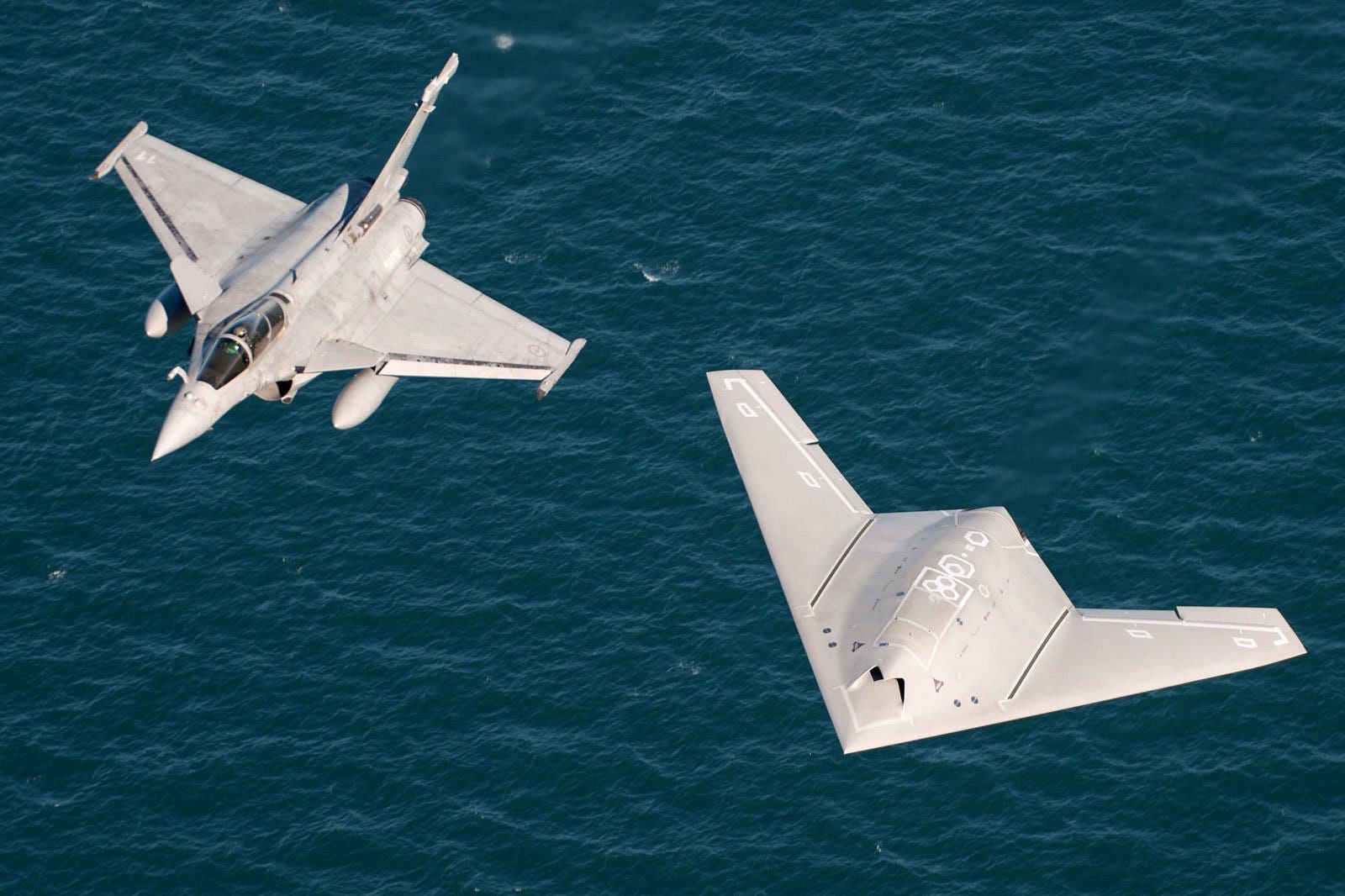
The nEUROn UCAV demonstrator was launched as a French initiative leading a six-nation cooperation including Italy, Sweden, Spain, Switzerland, and Greece. It first flew in December 2012 and proved low-observable design, autonomous flight, and weapons release in a stealth configuration.
In 2025, Dassault unveiled at the Paris Air Show a next-generation large stealth UCAV concept designed to operate alongside the Rafale F5 in a manned-unmanned teaming architecture. This sovereign UCAV path is increasingly important as the FCAS program governance becomes uncertain.
The strategic logic is direct: a Rafale F5 controlling sovereign French loyal wingmen could deliver effective sixth-generation-adjacent capability without depending on the FCAS New Generation Fighter timeline, which is widely understood to extend beyond 2040.
FCAS / SCAF: The Program at a Crossroads
The Future Combat Air System (FCAS, known in French as SCAF) is the trinational program between France, Germany, and Spain to develop a sixth-generation fighter system, with Dassault as prime for the New Generation Fighter and Airbus leading on the broader system of systems.
In early 2026, the program governance hit a public impasse. Eric Trappier publicly stated that Airbus was not respecting the FCAS agreement and questioned whether Dassault should remain in the program under existing terms.
FCAS / SCAF PROGRAM STATUS (April 2026)
- Phases: Demonstrator phase 1B contracted, phase 2 not yet signed
- Lead nations: France, Germany, Spain
- NGF prime: Dassault Aviation
- System of systems lead: Airbus Defence and Space
- Engine: Safran / MTU / ITP
- Current dispute: workshare and lead role on NGF
- Trappier deadline: two-to-three weeks (April 2026)
The April 2026 public deadline by Trappier signals a moment of truth.
If the dispute is resolved, the program advances to demonstrator phase 2.
If it is not, Paris faces a strategic choice between a sovereign Rafale F5 + UCAV roadmap, joining the GCAP program led by the UK, Italy, and Japan, or accepting a degraded FCAS architecture.
Other Programs: Atlantique 2, Falcon Albatros, and AVSIMAR
The French Navy operates a fleet of upgraded Atlantique 2 maritime patrol aircraft, with Dassault leading mid-life upgrades focused on mission systems, anti-submarine warfare, and connectivity.
Looking ahead, the Falcon 10 MRA (also referred to under the AVSIMAR / Albatros designation) is a derivative of the Falcon 2000LXS adapted for maritime surveillance and search-and-rescue, replacing the older Falcon 50M fleet for the French Navy. Initial deliveries have been ramping through 2025-2026.
Financial Analysis: Dassault Aviation
2025 Headline Results
Dassault Aviation reported 2025 net sales of EUR 7.42 billion, versus EUR 6.23 billion in 2024, an increase of 19.1%. The growth was driven by simultaneous progression of Rafale and Falcon deliveries: 26 Rafale (versus 21 in 2024) and 37 Falcon (versus 31 in 2024).
2025 KEY FINANCIALS
- Net sales: EUR 7.42 billion (vs EUR 6.23 bn 2024) +19.1%
- Adjusted operating income: EUR 635 million
- Adjusted operating margin: 8.6% (vs 8.3% 2024)
- Adjusted net income: EUR 1,061 million
- Adjusted net margin: 14.3% (vs 17.0% 2024)
- EPS (adjusted): EUR 13.60
- R&D self-financed: EUR 389 million (5.2% of sales)
Adjusted operating income climbed to EUR 635 million from EUR 519 million, a 22% increase. The operating margin expanded by 30 basis points to 8.6%, driven by improved Rafale program economics and better Falcon mix.
Adjusted net income of EUR 1,061 million was broadly flat versus EUR 1,056 million in 2024.
The flat profile reflects a smaller contribution from financial items relative to the very strong 2024 baseline that included larger interest income on heavy customer advance payments.
Backlog Quality and Visibility
The EUR 46.6 billion backlog is the most important number on the balance sheet. It comprises 220 Rafale and 73 Falcon, providing six-plus years of revenue visibility at 2025 delivery rates and roughly five-plus years at planned 2026-2029 rates.
BACKLOG MIX (31 December 2025)
- Total: EUR 46.6 billion
- Rafale total: 220 aircraft
  • Export Rafale: 175 aircraft
  • French Rafale: 45 aircraft
- Falcon: 73 aircraft
- Implied book-to-bill 2025: ~1.0x (orders broadly matching deliveries)
The composition matters. With 175 of 220 Rafales destined for export customers, the program’s downside resilience is partly insulated from any single-customer political risk.
India, Indonesia, the UAE, Greece, Egypt, Qatar, Croatia, and Serbia diversify the export book.
Cash Position and Capital Allocation
Dassault carries one of the strongest balance sheets in European aerospace and defense. Net cash exceeds EUR 8.5 billion, allowing the group to self-finance major R&D programs including the Falcon 10X without recourse to debt markets.
R&D spending in 2025 was EUR 389 million, or roughly 5.2% of sales, with the Falcon 10X as the dominant beneficiary. As 10X development moves from peak engineering to industrialization, that ratio is expected to moderate, freeing cash for capacity expansion and potential shareholder returns.
The dividend policy has historically been progressive, with payouts complemented by occasional share buybacks.
The conservative net cash stance is a strategic choice: it preserves optionality for vertical integration moves and gives Eric Trappier credibility when telling government partners that Dassault does not need a contract at any cost.
2026 Guidance and Forward Trajectory
Management guided to EUR 8.5 billion in 2026 net sales on planned deliveries of 28 Rafale and 40 Falcon. That implies roughly 14-15% growth versus 2025.
2026 GUIDANCE
- Net sales: ~EUR 8.5 billion (+14-15% YoY)
- Rafale deliveries: 28 (vs 26 in 2025)
- Falcon deliveries: 40 (vs 37 in 2025)
- Operating margin: trajectory toward continued expansion
- R&D: continued investment in Falcon 10X industrialization
The trajectory beyond 2026 is anchored to Rafale ramp toward four per month by 2029, plus the Falcon 10X entry into service planned around 2027-2028.
If both programs execute, 2029-2030 could see the company approaching EUR 10 billion in revenue with margins continuing to expand on absorption gains.
Dassault Aviation Revenue and Growth Drivers
Rafale Export Momentum
The structural driver is Rafale export demand. Cumulative Rafale orders reached 533 aircraft by end-2025, with the most recent waves coming from India, the UAE, Greece, Croatia, Indonesia, and Serbia.
CUMULATIVE RAFALE ORDERS (as of end-2025)
- France: ~234 (across multiple tranches)
- India (IAF + Navy): 62 (including recent order growth)
- UAE: 80
- Egypt: 55
- Indonesia: 42
- Qatar: 36
- Greece: 24
- Croatia: 12
- Serbia: 12
- Total cumulative: ~533
In February 2026, India’s Defence Acquisition Council authorized direct negotiations for 114 additional Rafales under the Multi-Role Fighter Aircraft program, with around 90-96 aircraft expected to be produced locally. If finalized, this is the single largest pending Rafale opportunity globally.
Indonesia has signaled it is not pursuing a follow-on Rafale order at this time, and the UAE relationship has become more measured.
These dynamics underline that the Rafale order pipeline is fragmented across many medium-sized opportunities rather than reliant on any single mega-deal.
India: From Customer to Industrial Partner
India’s role is shifting from buyer to manufacturing partner. In June 2025, Dassault signed four Production Transfer Agreements with Tata Advanced Systems Limited to manufacture Rafale fuselages in Hyderabad.
DASSAULT-TATA RAFALE PARTNERSHIP (signed June 2025)
- Scope: Rafale fighter fuselages
- Location: Hyderabad, India
- First fuselage sections off line: FY2028
- Eventual capacity: up to 2 complete fuselages per month
- Coverage: India deliveries plus global Rafale market
- Strategic context: Possible India-based final assembly for MRFA
This is a fundamental reshaping of Dassault’s industrial model. For decades, Mérignac has been the single point of Rafale assembly.
The Hyderabad fuselage line plus possible India-based MRFA final assembly creates a second center of gravity, lowering single-site risk and strengthening Dassault’s position in the world’s largest active fighter procurement market.
Falcon Recovery and the 10X Cycle
Civil Falcon revenue grew 22% in 2025 to EUR 2.77 billion. The recovery reflects normalization of the post-COVID supply chain, the Falcon 6X production ramp, and continued health in the ultra-high-net-worth segment.
The next leg up depends on Falcon 10X order momentum. Although Dassault has not disclosed the order book in detail, the Bordeaux unveil in March 2026 was carefully timed to demonstrate physical aircraft and ground tests, addressing skepticism about program timing.
Customer Support: A Quietly Compounding Annuity
Customer support is increasingly material. Dassault operates a worldwide Falcon Customer Services network of more than 60 service centers, of which 34 are company-owned, plus a military customer support organization supporting more than 1,000 military aircraft globally.
CUSTOMER SUPPORT FOOTPRINT
- 60+ Falcon service centers worldwide
- 34 company-owned centers
- 24/7 command center (USA + France)
- Military fleet supported: 1,000+ aircraft
- Spares hotlines globally distributed
- New MRO facility: Melbourne, Florida (Falcon 6X focus)
As the installed base grows, support and spares revenue compound steadily, providing margin-accretive recurring cash flows that smooth the lumpiness of new aircraft deliveries.
Last-Twelve-Months Revenue Posture
Last-twelve-months net sales aligned with calendar 2025 stand at EUR 7.42 billion.
The first-half 2025 delivered EUR 2.85 billion, meaning the second half ran at roughly EUR 4.57 billion as deliveries concentrated in the back half of the year, a typical Dassault pattern.
For 2026, the LTM trajectory is pointed toward EUR 8.5 billion, with the same back-loaded delivery profile likely.
Major Dassault Aviation Competitors
Dassault competes across two distinct landscapes, with limited overlap between them.
Defense (Combat Aircraft) Competitors
Lockheed Martin — F-35 Lightning II, F-16V Block 70/72
Boeing Defense, Space & Security — F-15EX Eagle II, F/A-18 Super Hornet
Eurofighter consortium — Eurofighter Typhoon (Airbus, BAE Systems, Leonardo)
Saab — Gripen E/F
KAI / Lockheed — KF-21 Boramae
Sukhoi / UAC — Su-35, Su-57 (sanctions-constrained)
Chengdu / AVIC — J-10C, J-20 (different geopolitical lane)
Civil (Business Aviation) Competitors
Gulfstream Aerospace — G500, G600, G700, G800
Bombardier — Global 5500/6500/7500/8000, Challenger 3500/650
Textron Aviation — Cessna Citation Longitude, Hemisphere
Embraer Executive Jets — Praetor 600, Phenom 300E
Honda Aircraft Company — HondaJet Echelon (smaller segment)
Dassault vs. Lockheed Martin
Lockheed Martin’s F-35 is the export benchmark Dassault must beat, and the head-to-head plays out aircraft-by-aircraft in tenders.
The F-35 offers genuine fifth-generation stealth, sensor fusion, and US alliance integration. The Rafale offers full sovereignty, no ITAR constraints, multi-role versatility, and a lower lifecycle cost profile.
For nations valuing political autonomy, nuclear strike capability, and freedom from US export controls (Egypt, India, the UAE, Indonesia), Rafale wins. For nations deeply embedded in US security architecture (Belgium, Finland, Switzerland, Poland), F-35 typically wins.
The F5 standard plus loyal wingman architecture is Dassault’s strategic answer to the F-35’s stealth and sensor fusion advantage, narrowing the capability gap without trying to match it head-to-head.
Dassault vs. Eurofighter Consortium
The Eurofighter Typhoon is Dassault’s most direct European competitor in the export market. Both aircraft are 4.5-generation, twin-engine, multi-role platforms.
Rafale’s advantages include carrier capability (the only NATO non-US fighter that can land on a US Navy carrier), nuclear strike, and a more unified industrial team. Eurofighter’s advantages include a larger production base, deep AESA radar development under the European Common Radar System Mark 2, and stronger air-to-air kinematics in some flight regimes.
The two have split European export tenders almost evenly over the past five years, and the upcoming Saudi and Turkish opportunities will be next-generation showdowns.
Dassault vs. Boeing Defense
Boeing’s F-15EX is a fundamentally different proposition: a fourth-generation-plus interceptor with extreme payload and range, primarily targeted at the US, Israel, Indonesia, and select Gulf customers.
Direct head-to-head with Rafale is rare; the platforms often coexist in the same air force.

In business aviation, Boeing is a non-factor since the Boeing Business Jet line (BBJ) targets a different VIP-airliner segment from Falcon’s purpose-built large-cabin twins and trijets.
Dassault vs. Gulfstream
In civil aviation, Gulfstream is the principal competitor. The Falcon 10X versus Gulfstream G700/G800 matchup is the marquee battle of the late-2020s ultra-long-range segment.

FALCON 10X vs GULFSTREAM G800 (per OEM specs)
- Falcon 10X range: 7,500 nm (Mach 0.85)
- Gulfstream G800 range: ~8,000 nm (Mach 0.85)
- Falcon 10X cabin width: largest in segment
- G800 cabin width: narrower
- Falcon 10X cabin altitude at FL410: 3,000 ft
- G800 cabin altitude at FL410: ~2,916 ft
- Falcon 10X engines: Rolls-Royce Pearl 10X
- G800 engines: Rolls-Royce Pearl 700
Falcon’s structural edge is cabin width and quietness; Gulfstream’s edge is range and US-market dominance. The Falcon 10X is positioned to take share from owners prioritizing cabin experience over absolute range.
Dassault vs. Bombardier
Bombardier’s Global 7500 has been the defining ultra-long-range product of the past five years, with the Global 8000 derivative pushing range to roughly 8,000 nm.
The Falcon 10X targets the same customers but emphasizes a more spacious cabin cross-section, all-new fly-by-wire derived from Rafale heritage, and 100% SAF-capable engines.
The competitive narrative is increasingly less about pure range and more about cabin experience, sustainability credentials, and reliability of post-sale support, all areas where Dassault has structural credibility.