Executive Summary
Berkshire Hathaway’s aerospace powerhouse demonstrates operational recovery despite pandemic challenges. Precision Castparts Corp (PCC), acquired for $37.2 billion in 2016, has transformed from Warren Buffett’s acknowledged mistake into a turnaround success story.
In 2024, PCC achieved revenues of $10.4 billion, marking a 12% increase from $9.3 billion in 2023. Pre-tax earnings surged 24.4% to approximately $1.9 billion. The company operates more than 120 facilities globally with 20,000 employees.
PCC’s recovery trajectory accelerated through 2025, with second-quarter results showing revenue growth of 1.6% to $2.7 billion and pre-tax earnings rocketing 37% upward.
This momentum positions the company as a critical beneficiary of commercial aerospace recovery extending through 2026 and beyond.
Also Read:
Table of Contents
Introduction
Precision Castparts manufactures mission-critical components that cannot be sourced elsewhere.
When a commercial aircraft engine operates at 2,500°F or a fighter jet performs high-G maneuvers, PCC’s investment castings, forgings, and fasteners must perform flawlessly.
This technological moat, built over six decades, creates sustainable competitive advantages that extend far beyond 2026.
Company Profile
Foundational Overview
Attribute | Details |
|---|---|
Founded | 1953 (Investment casting division of Oregon Saw Chain) |
Headquarters | Lake Oswego, Oregon |
Parent Company | Berkshire Hathaway (acquired January 2016) |
Employees | Approximately 20,000 worldwide |
Global Operations | 120+ manufacturing facilities across North America, Europe, and Asia |
Primary Markets | Commercial aerospace (60%+), defense aerospace (20%+), power generation (15%+) |
Business Segment Architecture
PCC operates through four integrated segments serving aerospace, defense, and industrial markets:
Investment Cast Products
- Structural investment castings (nickel, titanium, aluminum, steel)
- Airfoil castings for turbine engines
- Complex geometries impossible to forge or machine
Forged Products
- Aerospace-grade forgings (titanium, nickel superalloys, steel)
- Seamless pipe and fittings
- Specialized products for oil & gas applications
Airframe Products
- Fastening systems and specialty fasteners
- Complex aerostructures and assemblies
- Integrated structural components
Metals Products
- Premium nickel-based alloys
- Titanium mill products
- Revert services (metal recycling and reconditioning)
PCC’s vertical integration from raw materials to finished components creates operational synergies competitors cannot replicate.
Revenue Performance and Growth Drivers
Financial Trajectory 2023-2025
PCC’s financial resurgence demonstrates the company’s operational turnaround:
Period | Revenue | Pre-Tax Earnings | YoY Revenue Growth |
|---|---|---|---|
FY 2023 | $9.3 billion | $1.5 billion | +13.2% |
FY 2024 | $10.4 billion | $1.9 billion | +12.0% |
Q2 2025 | $2.7 billion | Pre-tax +37% | +1.6% |
The company surpassed pre-pandemic revenue levels in 2024, demonstrating complete recovery from COVID-19 disruptions that devastated aerospace supply chains.
Core Revenue Drivers Through 2026
Commercial Aircraft Production Ramp-Up
Boeing and Airbus combined delivered approximately 185 aircraft in December 2025 alone. Airbus achieved 793 deliveries for full-year 2025, while Boeing focused on recovery.
Industry projections indicate 1,044 Airbus and 708 Boeing deliveries for 2026, rising to 1,188 and 870 respectively in 2027.
PCC supplies components across next-generation platforms:
Boeing 737 MAX, 777X, 787 Dreamliner
Airbus A320neo family, A350 XWB
Regional jets from Embraer and Bombardier
Engine Manufacturing Surge
New engine programs drive disproportionate PCC content:
CFM International LEAP (powering 737 MAX and A320neo families)
GE9X (Boeing 777X powerplant)
Pratt & Whitney GTF (geared turbofan engines)
Rolls-Royce Trent XWB and UltraFan programs
Each new-generation engine contains 20-30% more PCC content than legacy powerplants due to increased use of advanced materials and complex geometries.
Defense Aerospace Stability
Military programs provide countercyclical revenue streams:
F-35 Lightning II (F135 engine components)
CH-53K heavy-lift helicopter
Various fighter and transport aircraft upgrades
Hypersonic weapon systems development
Defense contracts typically span decades, providing revenue visibility unmatched in commercial aerospace.
Aftermarket and MRO Expansion
The installed base of commercial aircraft exceeds 25,000 units globally. As fleet utilization normalizes post-pandemic, spare parts demand accelerates. PCC’s aftermarket revenues carry margins 40-50% higher than original equipment production.
Key Product Lines and Programs
Investment Castings: Engineering the Impossible
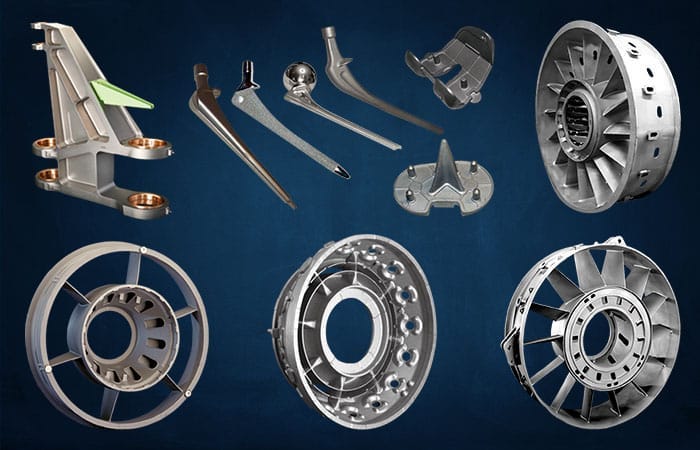
PCC pioneered large structural investment castings that revolutionized jet engine design. The company manufactures components weighing from ounces to several thousand pounds.
Turbine Engine Structural Castings
PCC produces structural frames that contain the massive forces within jet engines:
Mid-turbine frames
Turbine exhaust cases
Compressor cases and vanes
Bearing housings
These components operate in extreme environments where temperatures exceed 2,000°F and stresses approach material limits.
Airfoil Technology Leadership
The company leads globally in precision airfoil castings:
High-pressure turbine blades (single-crystal superalloys)
Low-pressure turbine blades and vanes
Compressor stator vanes
Industrial gas turbine components
PCC’s directional solidification and single-crystal casting processes create grain structures that dramatically improve high-temperature creep resistance.
Forged Components: Strength Where It Matters
PCC Forged Products manufactures mission-critical forgings in nickel superalloys, titanium, and specialized steels.
Aerospace Engine Forgings
Turbine discs and spacers
Compressor discs and hubs
Shafts and rings
Fan cases
Airframe Forgings
Landing gear components
Wing and fuselage structural fittings
Hydraulic system housings
Control surface attachments
The company operates hammer forges, isothermal presses, and ring rolling equipment spanning capacities from 500 to 50,000 tons.
Fastener Systems: Holding Everything Together
PCC Fasteners produces over 500 million fasteners annually for aerospace applications. These aren’t hardware store bolts; they’re precision-engineered systems:
High-strength structural fasteners
Specialty blind fasteners
Bolts, screws, and rivets
Installation tooling and equipment
A single Boeing 787 contains approximately 2.3 million fasteners. The 2025 SPS Technologies fire in Jenkintown, Pennsylvania, destroyed significant fastener capacity, underscoring PCC’s supply chain criticality.
Titanium Products: Lightweight Strength
Through its titanium operations, PCC manufactures:
Aerospace-grade titanium forgings
Seamless titanium tubing
Titanium castings
Custom titanium alloys
The company announced a new titanium facility in Ravenswood, West Virginia, designed to use 100% renewable energy for titanium production serving aerospace, defense, and medical markets.
Specialty Alloys: Controlling the Supply Chain
PCC’s metals segment provides vertical integration advantages:
Special Metals Corporation
Nickel-based superalloys (Inconel, Waspaloy, Hastelloy)
High-temperature alloy development
Billet, bar, and wire products
Cannon-Muskegon
Vacuum induction melting
Electroslag remelting
Proprietary alloy compositions
This internal capability insulates PCC from supply disruptions affecting competitors.
Major Competitors and Market Positioning
Competitor | Primary Strengths | Market Focus | PCC Advantages |
|---|---|---|---|
Howmet Aerospace | Integrated aerospace components, large installed base | Fasteners, forgings, castings | PCC’s titanium capabilities, larger structural castings |
Arconic | Aluminum and titanium products, automotive exposure | Aerospace aluminum, automotive | PCC’s nickel superalloy expertise, engine focus |
GKN Aerospace | Global presence, composite capabilities | Airframe structures, engine components | PCC’s vertical integration, material science leadership |
MTU Aero Engines | Engine MRO services, military engines | Commercial and military MRO | PCC’s OEM relationships, new production focus |
Competitive Differentiation
Technological Moats
PCC possesses manufacturing capabilities competitors cannot easily replicate:
Single-crystal turbine blade casting (decades of process knowledge)
Super-large structural casting (furnaces exceeding 100,000 pounds capacity)
Isothermal forging of titanium (specialized press equipment)
Proprietary alloy compositions (decades of metallurgical research)
Customer Entrenchment
PCC components receive certification for specific aircraft and engine models. Switching suppliers requires:
Multi-year qualification programs
Destructive testing and validation
Regulatory approvals (FAA, EASA)
Risk of program delays
This creates customer switching costs measured in tens of millions of dollars and years of development time.
Scale Advantages
With $10+ billion in aerospace revenue, PCC achieves economies of scale in:
Raw material purchasing power
Advanced manufacturing equipment investment
Engineering and metallurgical expertise
Quality control and testing capabilities
Competitive Dynamics in 2025-2026
Howmet Aerospace reported Q3 2025 net income of $385 million on strong aerospace demand. The company increased revenue 13.84% year-over-year, demonstrating industry-wide growth.
However, PCC’s pre-tax earnings growth of 37% in Q2 2025 significantly outpaced competitors, indicating operational leverage as production volumes increase.
The fire at PCC’s Jenkintown facility in February 2025 temporarily constrained fastener supply. This event highlighted aerospace supply chain fragility but also demonstrated PCC’s pricing power as customers scrambled for alternative capacity.
Recent Strategic Developments
Operational Excellence Initiatives
Manufacturing Technology Investment
PCC invested heavily in Industry 4.0 technologies:
Advanced process control systems
Real-time quality monitoring
Predictive maintenance capabilities
Digital twin simulations for casting and forging processes
These investments reduce scrap rates, improve yields, and accelerate production cycles.
Supply Chain Resilience Enhancement
Post-pandemic, PCC implemented:
Dual-source critical raw materials
Increased inventory buffers for long-lead items
Geographic diversification of production capacity
Enhanced supplier quality programs
Capacity Expansion Programs
Mason, Ohio Technology Center
PCC announced a $128 million investment in a new R&D engineering lab and manufacturing center in Mason, Ohio. This facility focuses on next-generation aerospace technologies and advanced manufacturing processes.
Ravenswood Titanium Facility
The new 100% renewable energy titanium plant positions PCC as a sustainable supplier addressing customer ESG requirements. Titanium demand for aerospace applications grows 8-10% annually.
Fire Recovery and Supply Chain Impact
The February 2025 fire at SPS Technologies in Jenkintown, Pennsylvania, destroyed much of the 560,000 square-foot fastener facility.
PCC responded by:
Redirecting production to other fastener facilities
Accelerating rebuilding plans
Implementing enhanced fire suppression systems across all facilities
Working with Boeing and Airbus to prioritize critical fastener deliveries
Industry analysts estimate the facility will return to full capacity by mid-2026. The event underscored aerospace industry dependence on PCC’s specialized capabilities.
Commercial Aerospace Recovery Dynamics
Boeing Production Trajectory
Boeing’s recovery from 737 MAX grounding and pandemic disruptions accelerated through 2025. The FAA approved increasing 737 MAX production from 38 to 42 aircraft monthly.
Production targets through 2027:
2026: 708 total Boeing deliveries
2027: 870 total deliveries
737 MAX rate: 50+ per month by late 2026
787 Dreamliner: Gradual increase to 10 per month
The 777X program faced delays, with first deliveries pushed to 2027 and a $5 billion charge. However, this represents deferred rather than lost revenue for PCC.
Airbus Market Leadership
Airbus delivered 793 commercial aircraft in 2025 and secured 1,000 new gross orders. The company maintains a commanding order backlog exceeding 8,700 aircraft.
A320neo family production targets:
Current rate: 65 aircraft per month
2026 target: 70-75 per month
Long-term goal: 80+ per month
A350 XWB production stabilizes at 10-12 aircraft monthly. Each widebody aircraft contains 3-4x the PCC content of narrowbody aircraft by value.
Engine Production Ramp-Up
Next-generation engine programs drive PCC revenue growth:
CFM LEAP Engines
2025 production: ~2,400 engines
2026 target: 2,600+ engines
PCC content: Approximately $400,000 per engine
Pratt & Whitney GTF
Overcoming durability issues through redesigned components
Production ramp-up supporting A320neo deliveries
PCC supplies critical titanium and nickel components
GE9X and Other Programs
777X entry into service drives initial production
Military engine programs (F135, F110) provide stable volumes
Industrial gas turbine recovery supports diversification
Financial and Commercial Implications
Margin Expansion Trajectory
PCC’s operational leverage generates significant margin improvement as volumes increase:
Operating Leverage Drivers
Fixed costs spread across higher production volumes
Manufacturing efficiency improvements reduce per-unit costs
Favorable product mix toward higher-margin aftermarket and new engines
Raw material cost inflation offset by pricing agreements
Pre-tax earnings growing 37% on revenue growth of 1.6% (Q2 2025) demonstrates operating leverage potential. As production volumes continue increasing through 2026-2027, this leverage amplifies.
Pricing Power Analysis
PCC’s specialized capabilities enable favorable pricing dynamics:
Long-Term Agreement Structure
Multi-year supply contracts with annual price adjustments
Inflation escalators tied to material and labor costs
Performance incentives for quality and on-time delivery
Aftermarket Premium Pricing
Spare parts carry margins 40-50% above OEM production
Shorter lead times command price premiums
AOG (aircraft on ground) situations support expedite fees
Capital Allocation Strategy
Under Berkshire Hathaway ownership, PCC focuses capital on:
Organic Growth Investments (60-70% of capital)
- Manufacturing capacity expansion
- Advanced equipment and technology
- R&D for next-generation materials and processes
Strategic Acquisitions (20-30%)
- Complementary technology capabilities
- Geographic expansion
- Vertical integration opportunities
Working Capital Management (10-20%)
- Inventory optimization for long-lead components
- Supplier financing programs
- Customer payment term negotiations
PCC does not pay dividends to Berkshire Hathaway, instead reinvesting all cash flow into organic and inorganic growth.
Raw Material Cost Management
PCC faces exposure to volatile commodity prices:
Material | % of Cost Base | Price Trend 2025 | Mitigation Strategy |
|---|---|---|---|
Nickel | 25-30% | Volatile, elevated | Internal alloy production, hedging |
Titanium | 20-25% | Moderately increasing | TIMET acquisition, long-term contracts |
Aluminum | 10-15% | Stable | Multi-source procurement |
Steel Alloys | 5-10% | Declining | Spot market purchases |
Vertical integration through Special Metals and titanium operations provides significant cost advantages versus competitors.
Image source: pccfasteners.com
Key Risks and Mitigation Strategies
Commercial Aerospace Cyclicality
Risk Profile: High
Description: Commercial aerospace historically experiences severe cyclical downturns every 7-10 years. The COVID-19 pandemic demonstrated industry vulnerability to exogenous shocks.
Scenarios:
Downside: Global economic recession reduces air travel demand, triggering aircraft order cancellations and production rate cuts. PCC revenue could decline 30-40%.
Base Case: Steady growth through 2026-2028 with normal cyclical variations. Revenue grows 8-12% annually.
Upside: Pent-up aircraft demand and fleet replacement needs drive production rates exceeding OEM capacity. Revenue grows 15%+ annually.
Mitigation Strategies:
Diversification into defense aerospace (countercyclical to commercial)
Aftermarket revenue streams less sensitive to new production cycles
Cost structure flexibility through variable labor and manufacturing capacity
Berkshire Hathaway’s balance sheet provides unlimited liquidity
Supply Chain Disruptions
Risk Profile: Moderate to High
Description: The Jenkintown fire demonstrated supply chain fragility. Raw material shortages, transportation disruptions, or additional facility incidents could constrain production.
Mitigation Strategies:
Geographic diversification of manufacturing capacity
Dual-source critical raw materials
Increased inventory buffers (60-90 days for critical components)
Enhanced fire suppression and disaster recovery capabilities
Vertical integration reduces dependence on external suppliers
Technological Disruption
Risk Profile: Low to Moderate
Description: Additive manufacturing (3D printing) and alternative materials could disrupt traditional casting and forging processes.
Scenarios:
Downside: Metal 3D printing achieves cost parity with investment casting for complex geometries. PCC loses market share in 15-20% of applications.
Base Case: Additive manufacturing complements rather than replaces traditional processes. PCC adopts technology for rapid prototyping and low-volume applications.
Mitigation Strategies:
Internal additive manufacturing R&D programs
Partnerships with leading 3D printing equipment manufacturers
Hybrid manufacturing approaches combining technologies
Process advantages in high-volume production remain sustainable
Raw Material Price Volatility
Risk Profile: Moderate
Description: Nickel, titanium, and other specialty metals experience significant price volatility. Sustained price increases could compress margins.
Mitigation Strategies:
Contractual pass-through clauses for material cost inflation
Vertical integration (Special Metals, titanium operations) reduces exposure
Strategic inventory management captures favorable pricing
Geographic diversification of supply sources
Regulatory and Certification Challenges
Risk Profile: Low
Description: Aerospace components require extensive testing and certification. Regulatory changes could increase costs or delay new product introductions.
Mitigation Strategies:
Decades of regulatory experience and relationships
Robust quality management systems (AS9100, Nadcap accreditations)
Early engagement in customer design processes
Global regulatory expertise (FAA, EASA, international authorities)
Defense Budget Uncertainty
Risk Profile: Moderate
Description: Government defense spending subject to political and fiscal pressures. Budget reductions could impact military aerospace programs.
Mitigation Strategies:
Diversified defense program portfolio (multiple aircraft, engine programs)
Focus on programs with bipartisan support (F-35, strategic deterrence)
International defense customers reduce U.S. budget dependence
Long program lifecycles (20-40 years) provide revenue visibility
Strategic Framework Analysis
SWOT Analysis Snapshot
Strengths | Weaknesses |
|---|---|
Global market leader in complex castings, forgings | High cyclicality tied to commercial aerospace |
Proprietary manufacturing processes and technologies | Capital-intensive business model |
Vertical integration from raw materials to finished components | Geographic concentration in legacy facilities |
Entrenched customer relationships (switching costs) | Limited diversification beyond aerospace/defense |
Berkshire Hathaway financial backing | $11 billion goodwill impairment (Buffett’s “mistake”) |
60+ years of metallurgical expertise | Workforce aging and skilled labor shortages |
Opportunities | Threats |
|---|---|
Commercial aerospace production ramp-up (2026-2028) | Economic recession reducing air travel demand |
Next-generation engine programs (higher PCC content) | Additive manufacturing disrupting traditional processes |
Defense modernization programs (F-35, next-gen fighters) | Supply chain disruptions (raw materials, transportation) |
Aftermarket growth from aging installed base | Competitor capacity additions increasing pricing pressure |
Sustainable aviation fuels driving engine redesigns | Geopolitical tensions impacting international operations |
Emerging markets aerospace growth (China, India) | Raw material price volatility (nickel, titanium) |
Porter’s Five Forces Analysis
Force | Intensity | Analysis |
|---|---|---|
Competitive Rivalry | Moderate | Concentrated industry with 3-4 major players. Competition based on technology and quality rather than price. Long-term customer relationships reduce switching. |
Threat of New Entrants | Low | Enormous capital requirements ($500M+ for competitive facility). Decades required to develop metallurgical expertise. Regulatory certifications create multi-year barriers. |
Bargaining Power of Suppliers | Low to Moderate | PCC’s vertical integration (Special Metals, titanium) reduces supplier dependence. Commodity materials sourced from multiple suppliers. Specialty materials require long-term partnerships. |
Bargaining Power of Buyers | Moderate to High | Concentrated customer base (Boeing, Airbus, GE, P&W, Rolls-Royce represent 60%+ of revenue). Customers possess significant negotiating leverage. However, switching costs limit customer power. |
Threat of Substitutes | Low | No viable substitutes for investment castings in many applications. Additive manufacturing remains cost-prohibitive for high-volume production. Materials science advantages difficult to replicate. |
Overall Industry Attractiveness: Moderate to High
Despite buyer power, the aerospace supply chain offers attractive returns for established players with technological capabilities and scale advantages.
PESTEL Analysis Snapshot
Factor | Impact | Key Considerations |
|---|---|---|
Political | Moderate | Defense spending priorities; trade policies; government aerospace programs; export controls on military technology |
Economic | High | GDP growth correlation with air travel; interest rates affecting aircraft financing; currency exchange rates; raw material prices |
Social | Low to Moderate | Skilled workforce availability; aerospace industry brain drain as workforce ages; STEM education priorities |
Technological | High | Additive manufacturing evolution; advanced materials development; automation and Industry 4.0; sustainable aviation fuel impacts |
Environmental | Moderate | Emissions regulations driving fuel-efficient engines; sustainable manufacturing requirements; renewable energy adoption |
Legal | Moderate | Aerospace certification requirements; environmental regulations; labor laws; intellectual property protection |
Stakeholder Implications
OEMs (Boeing, Airbus, Engine Manufacturers)
Actionable Insights:
Secure long-term supply agreements before capacity constraints emerge
Collaborate on next-generation material development for future programs
Invest in supplier financial health monitoring to prevent disruptions
Evaluate dual-source strategies for risk mitigation balanced against PCC’s capabilities
Airlines and Operators
Actionable Insights:
Monitor PCC production capacity as leading indicator of aircraft delivery schedules
Aftermarket parts availability may tighten; secure spare parts inventories
New aircraft delays possible if supply chain constraints emerge
Older aircraft retirement decisions should consider parts availability
Defense Procurement Offices
Actionable Insights:
PCC capacity allocation prioritizes commercial aerospace; potential military program delays
Consider long-term agreements locking in capacity for critical defense programs
Monitor commercial aerospace cycles for defense program cost impacts
Evaluate alternative suppliers for less critical applications
Suppliers to PCC
Actionable Insights:
Volume growth creates expansion opportunities for PCC’s supply base
Quality and delivery performance increasingly critical as production ramps
Consolidation risk as PCC backward integrates strategically
Innovation partnerships offer growth beyond commodity supply
Competitors
Actionable Insights:
PCC’s operational leverage advantage accelerates as volumes increase
Capacity additions by competitors risk oversupply when cycle turns
Technology investments in additive manufacturing and automation critical
Vertical integration strategies require significant capital but offer long-term advantages
Financial Analysts (Industry Analysts, Not Investors)
Actionable Insights:
Pre-tax earnings growth significantly outpacing revenue indicates margin expansion
Q2 2025 results (37% earnings growth on 1.6% revenue growth) demonstrate leverage
Aftermarket mix improvement supports higher consolidated margins
Raw material inflation risks manageable through vertical integration and pricing power
Primary Sources and Data References
Company Official Sources
Supply Chain and Operational Analysis
Competitive Intelligence
My Final Thoughts
Precision Castparts Corp weathered the pandemic-induced aerospace collapse and emerged with a leaner cost structure positioned for the commercial aerospace recovery extending through 2026 and beyond.
Three factors distinguish PCC’s trajectory from competitors.
First, technological moats create sustainable advantages. Single-crystal turbine blade casting, super-large structural investment castings, and proprietary alloy compositions require decades to replicate. These aren’t manufacturing processes competitors can acquire through capital investment alone.
Second, vertical integration from raw materials through finished components provides cost advantages and supply chain resilience. While competitors scrambled during pandemic-era material shortages, PCC’s Special Metals and titanium operations maintained supply continuity.
Third, operational leverage amplifies earnings growth as aerospace production volumes increase. Q2 2025 demonstrated this phenomenon: 1.6% revenue growth generated 37% pre-tax earnings growth. As Boeing and Airbus production rates continue climbing through 2027, this leverage compounds.
The February 2025 Jenkintown fire, while destructive, paradoxically demonstrated PCC’s strategic value. Aerospace manufacturers possess few alternatives for specialized fasteners, investment castings, and forgings.
This irreplaceability translates into pricing power and customer retention that transcends normal supplier relationships.
For 2026 and beyond, commercial aerospace recovery represents the dominant narrative.
However, defense aerospace, aftermarket growth, and industrial gas turbine applications provide diversification that earlier generations of PCC lacked. The company has evolved from a cyclical aerospace supplier into a diversified advanced manufacturing enterprise.
Warren Buffett’s admission that he “paid too much” for PCC at $235 per share in 2016 reflected pandemic-era valuations and operational challenges.
However, the company’s subsequent transformation demonstrates why Berkshire Hathaway maintains a decades-long investment horizon. Sometimes the best acquisitions require patience to realize their full potential.
The critical question for aerospace industry stakeholders centers not on whether PCC will benefit from commercial aerospace recovery but rather on how supply chain bottlenecks might constrain the pace of that recovery.
PCC’s capacity utilization approaching 90% suggests production constraints could emerge by late 2026 without additional capacity investments.
The company’s announced expansions in Mason, Ohio, and Ravenswood, West Virginia, indicate management anticipates sustained demand. These investments position PCC to capture disproportionate value as aerospace production rates climb toward historical peaks.
For aerospace industry professionals, PCC’s performance serves as a leading indicator for supply chain health. When PCC reports accelerating revenue growth and margin expansion, aerospace production ramp-ups are proceeding as planned.
Conversely, PCC challenges signal broader supply chain constraints affecting aircraft delivery schedules.
The next 24 months will determine whether PCC’s operational improvements represent permanent transformation or cyclical recovery. Early evidence suggests the former.
The company has demonstrated pricing power, operational efficiency, and strategic positioning that should sustain performance well beyond the current aerospace upcycle.